LinkedIn Content for SaaS Founders 2026: The Complete Playbook
LinkedIn is uniquely suited for SaaS founders. Your target customers are on LinkedIn. Your investors are on LinkedIn. Your future hires are on LinkedIn. But most SaaS founders approach content the same way they'd approach a blog—broad, educational, generic. SaaS demands a different strategy.
SaaS founder content on LinkedIn should accomplish specific business goals: drive product demos, generate qualified leads, position yourself for fundraising, attract talent, and build a customer community. Generic thought leadership helps, but it's only one part of the strategy.
The best SaaS founder LinkedIn strategies combine four types of content in a deliberate mix: customer wins and metrics (proof of traction), product updates and features (narrative of progress), fundraising and growth stories (founder narrative and transparency), and educational content (genuine value-add). When mixed properly, they create a narrative that shows traction, vision, and execution simultaneously.
This guide walks you through the specific content types that work for SaaS, the optimal content mix, how to share metrics without giving away secrets, how to position fundraising without being desperate, and how to build a community of customers and future customers.
Table of Contents
- Why SaaS Needs a Different LinkedIn Strategy
- The SaaS Content Mix Framework
- Customer Stories and Metrics Sharing
- Product Updates and Feature Launches
- Fundraising and Growth Narrative
- Educational Content That Drives Demo Requests
- Engagement Benchmarks and Success Metrics
- Building Community and Sampling
- Frequently Asked Questions
Why SaaS Needs a Different LinkedIn Strategy
A venture capitalist on LinkedIn wants to see founder credibility. A potential customer wants to see proof that your product works. A software engineer wants to see that you're solving real problems. A general "thought leadership" strategy doesn't speak to all three audiences simultaneously—but a thoughtful SaaS strategy does.
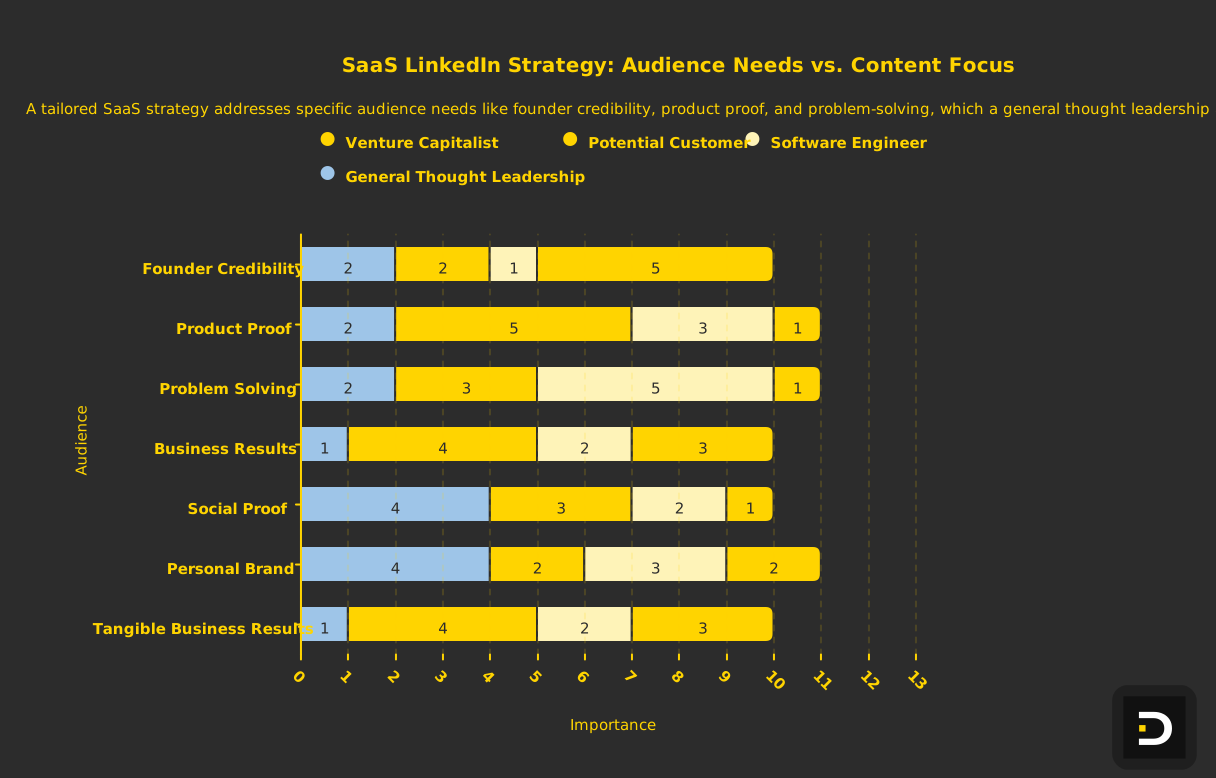
SaaS founder content needs to accomplish two simultaneous goals: build credibility as a founder (so investors, customers, and talent take you seriously) and generate tangible business results (leads, demos, applications, customers). For a consumer business, social proof and personal brand might be enough. For SaaS, you need both brand AND bottom-line results.
The content mix matters more than individual post quality. A single brilliant post that gets 2,000 likes is less valuable than ten solid posts that generate 5 SQL (sales qualified leads) each. The right mix of content types compounds: customer wins build trust that increases sales, product announcements show momentum that helps hiring, fundraising updates position you better with investors, and educational content demonstrates expertise and builds community.
The goal is a content strategy that's simultaneously pushing prospects through your funnel, building your personal brand, and telling the story of a founder who's building something real and gaining traction.
The SaaS Content Mix Framework
The ideal SaaS founder content mix has four pillars. Monthly, your content should be distributed roughly as follows:
40% Customer wins and metrics — These are the highest-impact posts for SaaS. Publicly sharing customer results, metrics, or growth milestones signals to everyone (prospects, investors, partners) that your product works. 2 posts per week if you're posting 5x/week, 1 post per week if you're posting 2x/week.
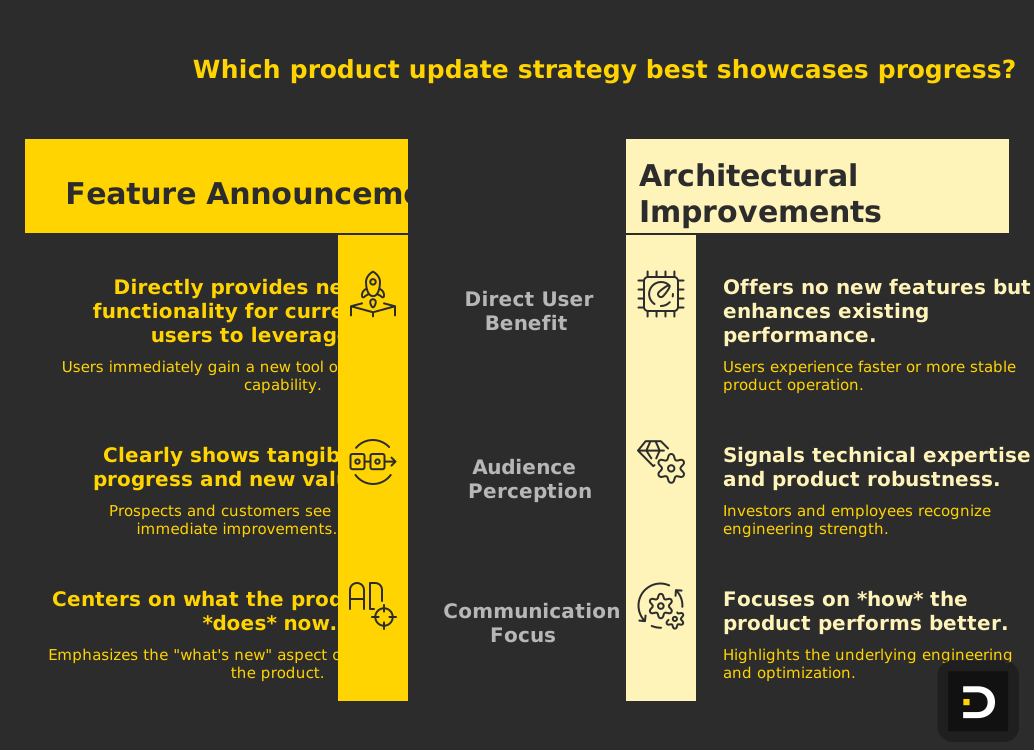
25% Product narrative (updates, features, launches) — These show momentum and progress. Prospects want to see that you're actively building. Investors want to see that you're shipping. Content here includes new feature announcements, product milestones, architectural improvements, and roadmap transparency. 1 post per week.
20% Founder narrative (fundraising, growth, lessons) — These build personal credibility and transparency. They answer the question: "Why should I work with this founder?" Content here includes fundraising announcements (with context and impact), lessons learned, hiring transparency, and founder perspective on building. 1 post per week.
15% Educational or market insight — This is thought leadership, but framed through the lens of your market. It's insights you've learned building your product, not generic advice. For a SaaS company, this might be "5 mistakes we see in how teams implement API security" or "Why most data warehouse migrations fail (and how to avoid it)." 1 post per 2 weeks.
This 40-25-20-15 mix creates narrative coherence. Your audience understands your company is gaining traction (customer wins), actively building (product narrative), and positioned by a competent founder (founder narrative). The small percentage of educational content adds authority without overtaking the business narrative.
Customer Stories and Metrics Sharing
This is the most powerful content for SaaS founders, and it's also the most intimidating. How do you share customer results without violating NDAs or giving away your CAC?
Types of customer win content:
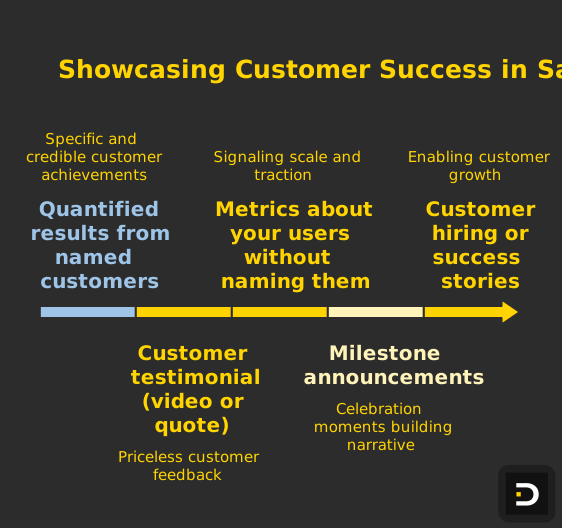
Quantified results from named customers — "Customer X built an API in 50% less time using our platform, down from 3 weeks to 10 days." This is specific, credible, and immediately valuable to a prospect considering you. If the customer is willing to be named, use their name. If not, anonymize: "One of our healthcare customers reduced API development time by 50%, down from 3 weeks to 10 days."
Customer testimonial (video or quote) — A few minutes of a customer saying how you helped them is priceless. Video testimonials showing a real person talking about real results get exceptional engagement and credibility.
Metrics about your users without naming them — "500+ companies now use [Product] for API development. Here's what they're building." This signals scale and traction without revealing individual customers.
Milestone announcements — "Just hit 10,000 active users," "Processed 1B API calls this month," "Customers report 40% reduction in security incidents." These are celebration moments that build narrative momentum.
Customer hiring or success stories — "One of our customers just hired their first VP of Security. Here's how [Product] helped them scale." This shows that your product is enabling growth for your customers.
How to structure customer win content:
Opening hook (1–2 sentences): Why should someone care about this particular result? "Most infrastructure migrations fail. Here's what happens when they don't."
The customer context (1–2 sentences): Who is the customer? What was their situation? "A Series B SaaS company with 50 engineers, using legacy infrastructure from 2015."
The result (1–2 sentences): What changed? Quantified if possible. "Migrated to cloud infrastructure in 8 weeks instead of 6 months. Reduced infrastructure costs by 30%."
The why (1 sentence): What made this possible? "Our platform automated the most time-consuming parts of migration."
Close with open question: "What's the biggest infrastructure challenge your team is facing?"
Example of a well-structured customer win:
"One of our most impressive migrations just finished. A Series B fintech company moved 500K+ microservices from on-prem to Kubernetes. Old timeline estimate: 18 months. Actual time: 4 months.
The challenge: their legacy orchestration system was hand-coded and brittle. Any change risked downtime. Moving everything required rearchitecting from scratch.
The result: using our platform, they automated 70% of the migration, cut the timeline by 75%, and improved system reliability by 40%.
The CEO told me this was the difference between their growth trajectory and their stagnation. They were stuck. Now they're building the next generation of their product.
If you're facing a major infrastructure migration, curious what you're most worried about?"
This post accomplishes multiple things simultaneously: it's social proof for prospects evaluating you, it's a candidate magnet (people want to work at companies shipping this fast), it builds founder credibility (you understand your customer's problems), and it's celebration-worthy enough that it drives engagement.
Metrics sharing best practices:
Share enough detail to be credible. "We're growing" is useless. "ARR grew 150% YoY to $2M" is credible and impressive.
Don't share your CAC, LTV, or other competitive metrics. Share customer results and company traction, not unit economics.
Share metrics that matter. For a SaaS company, important metrics include: ARR/MRR growth, customer count and growth, key user metrics (API calls, active users, etc.), or customer outcome metrics (their improvement). Vanity metrics (office size, employee count) matter less.
Benchmark against industry. If you're growing 150%, that's only impressive if your market average is 30%. Context matters.
Share regularly. One metric post occasionally has limited impact. When metrics sharing becomes part of your regular cadence, it compounds—your audience starts to see a narrative of consistent growth.
Product Updates and Feature Launches
SaaS founders live and die by shipping. Your audience (prospects, investors, customers, employees) all want to see evidence of consistent progress.
Types of product content:
Feature announcements — New capability your product has. "We just shipped request grouping—automatically combine related API requests into a single batch. Reduces latency by 40% for common scenarios." This is valuable to current users (they get to use the feature) and prospects (they see the product is actively improving).
Architectural improvements — Under-the-hood progress that doesn't create a new feature but improves the product. "We rebuilt our query engine from scratch. Same features, 3x faster at scale. Details in our engineering blog." This signals technical competence.
Roadmap transparency — What's coming next. "Next quarter we're shipping data federation, request prioritization, and a new mobile experience. Most requested by customers." This builds anticipation and signals you're responsive to customer needs.
Scaling milestones — Proof that your product works at scale. "Processing 1B API requests per month, up from 500M six months ago. Zero degradation in latency even during peak times." This reassures prospects that your product won't fall apart when they scale.
Product retrospectives — Lessons learned from shipping something. "We shipped our redesign two months ago. Here's what we learned: (1) users need backwards compatibility more than we expected, (2) dark mode became our most-requested feature once available, (3) we should have shipped mobile first."
How to structure product announcement content:
Headline that conveys value (not feature name): Not "We shipped Request Batching v2.0." Better: "Reduce API latency by 40%—here's how."
The problem it solves (1–2 sentences): Why does this matter? "Most teams building at scale fight latency in their API layer. Some resort to expensive caching or expensive hardware."
The solution (1–2 sentences): What did you build? "We built automatic request batching. Group related requests into a single batch with a single network call. Reduces latency by 40% for common scenarios."
The impact (1 sentence): Why should someone care? "This turns expensive scaling problems into free performance wins."
Close with CTA: "If you're hitting latency issues in production, want to try request batching? Happy to get you access."
Example of a strong product announcement:
"We just shipped something our customers have been asking for since day one: webhooks.
The problem: most teams building with our API want real-time notifications when things change. They were polling our API constantly, burning quota and burning through their infrastructure bill.
The solution: native webhooks. Subscribe to events (object created, updated, deleted). We notify you instantly. No more polling. One customer estimates this saves them $20K/month in infrastructure costs.
This is live today for all customers. If you're using our API and have been looking for webhooks, go try it.
Shoutout to [person's] team who built this—they did it in four weeks and made it extensible enough that we'll have zero technical debt adding new event types."
This announcement does multiple things: it solves a real customer problem, it shows you're responsive to customer requests, it quantifies impact, it credits the team (good for recruiting), and it signals ongoing product maturity.
Fundraising and Growth Narrative
When you're raising capital, LinkedIn is one of your strongest tools for positioning. But most founders approach fundraising transparency wrong—they either hide it completely or come across as desperate.
The right approach: transparency about your growth and momentum, combined with your thesis about the market and your execution edge.
Types of fundraising content:
Funding announcements (with context) — "Just closed Series A." alone is boring. Better: "Just closed $8M Series A with Sequoia. Here's what this means: we're now 100% focused on solving compliance for edge-deployed AI systems. We could scale our current product. We're choosing to solve a harder problem because the market is shifting. Details on our blog."
Hiring announcements — Fundraising means growth. Capitalize on this momentum. "Series A is closed. We're hiring 8 engineers this year. If you've solved distributed systems at scale, let's talk." This creates a double narrative: we're funded (credible), we're hiring (growing), you should join.
Metrics that show traction — Share your growth story through numbers. "When we started fundraising, we had $200K ARR and 20 customers. We closed our round at $500K ARR and 40 customers. Here's what changed." This shows both business growth and founder focus (numbers during the fundraising process).
Founder openness about challenges — "Fundraising is brutal. Here's what surprised me: [1] finding a partner who gets the space is harder than finding capital, [2] most LPs are not as contrarian as they claim, [3] conviction is worth more than size." This positions you as a real founder with perspective, not just a capital-chasing hype machine.
Post-announcement updates — After you close, share what you'll do with the capital. This keeps momentum going and shows strategic thinking. "Now that Series A is closed, here's our priorities: [1] Build out our platform for edge deployment, [2] Expand our TAM beyond the tech vertical, [3] Build a world-class founding team."
How to structure fundraising announcement:
Don't lead with the size of the round. Lead with what it means for your product or market. "We just closed $8M Series A to scale [specific product/market problem]." Then add: "This capital will let us solve X, hire Y, expand into Z."
Share your thesis. Why did you choose this investor? Why is this the right time to raise? "We found a partner in [Investor] who deeply understands the edge deployment problem. They've backed three companies in adjacent spaces and brought all three to $100M+ exits. Plus, the market is shifting: 40% of workloads are moving to edge by 2026. This is the moment to build."
Show gratitude to your team. "This fundraise was possible because of our engineering team and our early customers. They pushed us to solve real problems and it shows in our metrics."
Example of a strong fundraising announcement:
"We just closed our Series A. $10M from Sapphire, Initialized, and angels including [name] and [name].
A year ago, we had $100K ARR and one major customer. Today: $800K ARR, 15 customers, and a waiting list of 200+.
Why did we raise? Two reasons. First, the market is moving faster than we expected. Enterprise teams are ready to migrate to cloud-native infrastructure way earlier than anyone predicted. Second, we were staying nights and weekends to keep up. Now we can hire the team we need to ship the roadmap.
What we're building: the infrastructure layer for teams moving from legacy systems to cloud. Not Kubernetes tools. Not cloud migration consultants. Something fundamentally new.
If you want to help us build this, we're hiring: 2 infrastructure engineers, 1 product manager, 1 go-to-market. If you've solved scaling problems at fortune 500 companies, reach out.
Thanks to our early customers who made this possible. You pushed us to build product that actually matters."
This announcement establishes: traction (metrics), market insight (why now), team momentum (hiring), and founder credibility (specific execution). It's not just an announcement—it's narrative positioning.
Educational Content That Drives Demo Requests
Thought leadership works for SaaS, but only if it's directly relevant to your market and drives action.
Types of educational content that work:
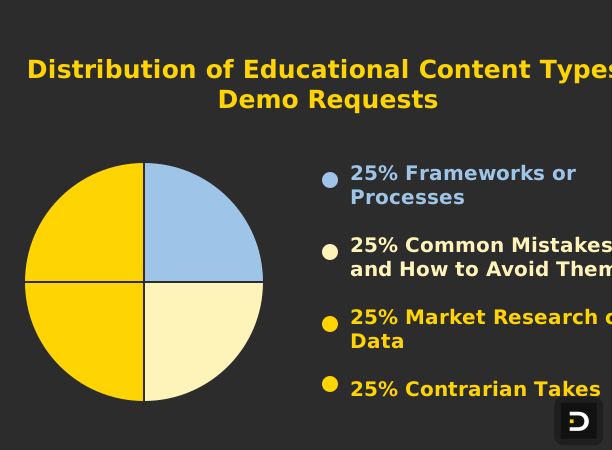
Frameworks or processes — Share the methodology you've developed. "Here's how we evaluate database migration risk: [5-step framework]." This is genuinely valuable to your audience and positions you as expert. Bonus: when someone uses your framework and hits a gap, they realize they need your product.
Common mistakes and how to avoid them — "We see five mistakes teams make when deploying to edge: [1] underestimating latency impact, [2] not planning for connectivity failure, [3] choosing the wrong orchestration model..." This positions you as someone who understands the space deeply and helps prospects avoid costly mistakes.
Market research or data — Share original research if you have it. "We surveyed 200 infrastructure teams about their biggest challenges. Here are the top 5 responses and what they mean." This establishes authority and gives people reason to engage.
Contrarian takes — Challenge conventional wisdom. "Stop migrating to Kubernetes. Here's why most teams should migrate to managed container platforms instead." This is spicy enough to drive engagement but grounded in real reasoning.
Case study or deep dive — Go deep on a problem. "This company solved X. Here's their approach, their mistakes, and what they'd do differently." This is valuable narrative + learning + social proof.
How to position educational content for demo generation:
End with a specific question that invites conversation. "What's the biggest challenge you're running into with [problem space]?" This invites comment replies that you can respond to and move into a conversation.
Mention your product subtly as context, not pitch. "At [Company], we see this mistake constantly. Here's how to avoid it. (And yes, this is exactly what our product solves, but more importantly, here's the principle.)" This positions your product as the natural solution without hard-selling.
Offer a deeper dive. "I could talk about this for hours. If you want to dive deeper, let's talk." This opens a door for demo requests.
Example of educational content that drives demos:
"Most teams fail at API rate limiting. Here's why and how to fix it.
The mistake: teams build rate limiting based on user tier (gold users get 10k calls/day, silver get 1k). Then one gold customer sends 500 requests per second and kills the service.
Why this fails: tier-based limits assume even distribution. Real usage is never even.
The right approach: distributed rate limiting. Every user gets a quota, but the service tracks real-time usage and degrades gracefully. One customer hitting their limit doesn't affect others.
Implementation matters. Most teams try to implement this themselves. (I see it go wrong constantly.) The math is harder than it looks and the bugs are subtle.
If you're building an API and want to talk about how to implement distributed rate limiting without the headaches, happy to share what we've learned."
This post educates genuinely, positions you as expert, identifies a pain point, and opens a door to conversation/demos.
Engagement Benchmarks and Success Metrics
How do you know if your SaaS LinkedIn strategy is working?
Key metrics to track:
Engagement rate — Comments and shares divided by views. For SaaS content, aim for 2–5% engagement rate. Customer win posts typically perform at 4–8%. Product announcement posts 2–4%. Educational content 2–3%.
Demo requests and sales qualified leads — This is the real metric. Track how many people mention "saw your LinkedIn post" in initial conversations or demo requests. After 30 days of consistent posting, this should be 1–3 demo requests per week. After 90 days, 3–5 per week. After 6 months, 5–10 per week.
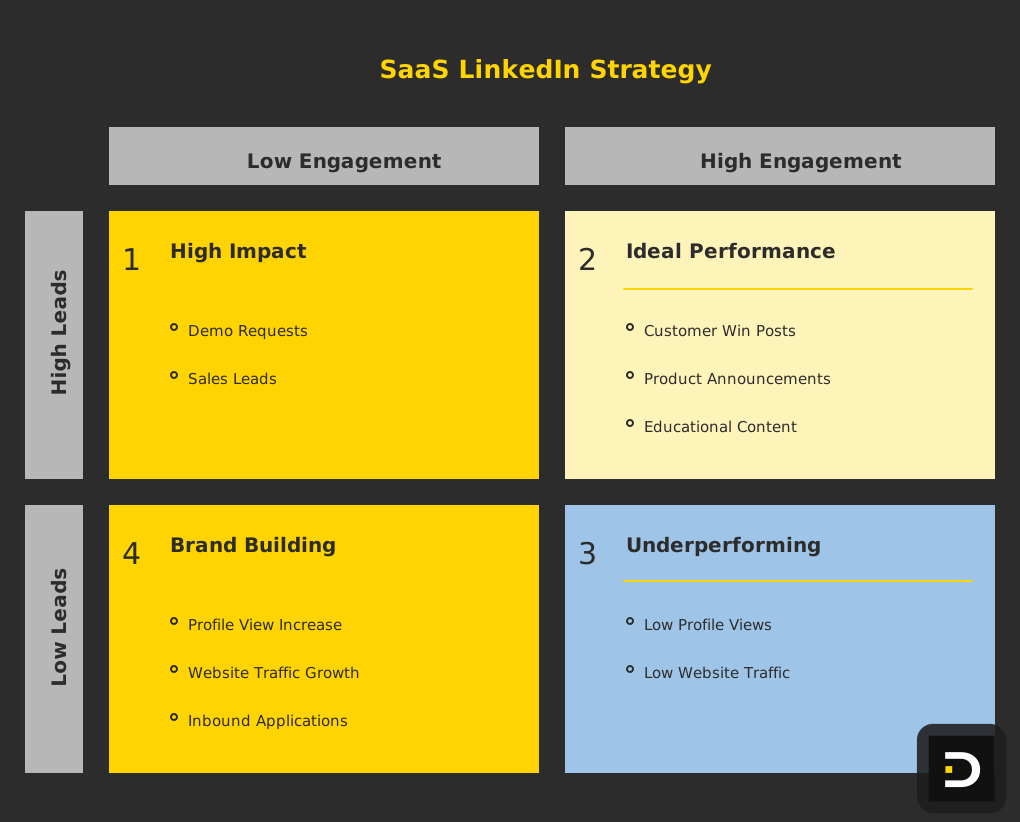
Inbound applications — Sharing your hiring plans should drive applications from LinkedIn. After you post "we're hiring," track applications mentioning LinkedIn as source.
Profile view increase — Consistent posting increases profile views. Expect 30–50% increase in monthly profile views after three months of consistent posting.
Website traffic from LinkedIn — Use UTM parameters on links you share. Track how much traffic comes from LinkedIn. This should grow from ~5–10% of referral traffic (if you weren't posting) to 20–40% within 6 months.
Benchmark expectations by stage:
Seed stage: 2–4 demo requests per month from LinkedIn, 20–50 profile views per week, 1–2 hiring applications per week if you're hiring.
Series A: 5–15 demo requests per month from LinkedIn, 100–200 profile views per week, 5–10 hiring applications per week, 10–20% of new customers mentioning LinkedIn as discovery source.
Series B and beyond: 20–50 demo requests per month from LinkedIn, 500+ profile views per week, 20–50 hiring applications per week, 25–50% of new customers mentioning LinkedIn as discovery source.
These benchmarks assume consistent, strategic posting (3–5 posts per week) using the content mix framework above.
Building Community and Sampling
The endgame of SaaS LinkedIn strategy isn't just leads—it's community. When you build a regular audience of prospects, customers, and industry peers, you've created a distribution channel and a feedback loop simultaneously.
Community-building tactics:
Consistent, predictable posting — Your audience should know when to expect you. If you post every Tuesday and Thursday morning, people start checking for your posts. This habit-building is powerful.
Responding to every meaningful comment — For the first 50 comments on a post, respond personally. This signals that you care about engagement and not just reach. Over time, it builds relationships.
Sampling and access — Give your audience early access to new features. "If you want to try request batching before general availability, let me know." This creates urgency and builds a community of early adopters who become advocates.
Live sessions or interviews — Go live on LinkedIn and interview customers, other founders, or experts. Live video gets algorithmic boost and creates a shared experience with your community.
Aggregating community insights — When your audience shares challenges or learnings in comments, occasionally compile them into a larger post. "This thread got me thinking about the biggest edge deployment challenges. Here's what you all told me, and here's what we're doing about it."
Building loyalty through transparency — Share your roadmap, your challenges, your wins. When people feel like insiders to your journey, they become advocates.
Frequently Asked Questions
Should I share my unit economics or sensitive metrics?
No. Share what matters to prospects (customer results, company growth), not what matters to competitors (CAC, LTV, churn). Share ARR and customer growth. Don't share your pricing, your unit economics, or your detailed TAM analysis.
How do I share customer stories without violating NDAs?
Ask customers for permission. Most will say yes if you ask. If they won't be named, anonymize. "One of our fintech customers reduced their API development time by 50%" is fine and still credible.
When should I announce funding?
Announce after the money hits the bank, not before. Some founders announce early, but you risk embarrassment if the deal falls through. Also, the announcement is more powerful if you can show metrics the round enabled. "Just closed Series A. We're now at $1M ARR" is stronger than "Just closed Series A. We're at $200K ARR."
Should I post about failed experiments or setbacks?
Selectively, yes. "We tried feature X. Turns out customers didn't want it. Here's what we learned." This builds trust and authenticity. Don't post about every failed experiment, but significant ones (especially if you're pivoting your strategy) are worth sharing.
How do I avoid looking desperate when fundraising?
Don't lead with fundraising. Lead with traction. Share metrics, customer wins, product progress. In that context, "Series A is now open" doesn't look desperate—it looks inevitable. Desperation comes from talking about your round before you've built real traction.
Can I repurpose the same customer win in multiple posts?
Yes, but frame it differently. "Here's how [Customer] achieved 40% cost reduction" (internal framing). "Why infrastructure cost reduction matters more than you think: [Customer] case study" (market education framing). Same story, different angles.
Ready to Build Your LinkedIn Thought Leadership?
SaaS founder LinkedIn strategy is different from generic thought leadership because it has to work harder. It needs to generate leads, build your brand, attract talent, and position you for fundraising simultaneously.
The 40-25-20-15 content mix (customer wins, product narrative, founder narrative, education) creates that compound effect. Each piece of content works together to tell the story: this founder is executing, this product is gaining traction, this company is moving fast.
Start with customer wins. These are your highest-impact content type. Share one customer result per week. After a month, add product updates. After two months, add founder narrative. After three months, add educational content. Build it layer by layer.
For a deeper dive on founder narrative strategy, check out founder-led-marketing-linkedin or explore how this fits into your broader executive-linkedin-content-strategy-2026.
Your SaaS company is unique. Your customer problems are unique. Your traction story is unique. Share it consistently on LinkedIn, and watch what happens to your pipeline.