How to Hire a LinkedIn Ghostwriter: Complete Process & RFP Guide
You've decided you need a LinkedIn ghostwriter. Good call. But how do you actually find one? How do you know if they're any good? What questions do you ask? What happens when you disagree on direction?
This guide walks you through the entire hiring process: where to find ghostwriters, what to evaluate, the trial period, contract terms, and how to manage the relationship so you get great work.
Table of Contents
- Where to Find LinkedIn Ghostwriters
- What to Look For (Red Flags and Green Flags)
- The Interview Process: Questions That Matter
- Evaluating Ghostwriter Samples
- The Trial Period (4–6 Weeks)
- Contract Terms and Pricing
- Managing the Ongoing Relationship
- When to Switch Ghostwriters
- RFP Template and Hiring Checklist
- FAQ: Hiring Process Questions
Where to Find LinkedIn Ghostwriters
The ghostwriting market is fragmented. You have three main channels:
1. Agencies Specializing in Founder-Led Content
Examples: Foundera, Letterly, Modular.
Pros: Vetted writers, industry expertise, ongoing support, templates and processes
Cons: Higher cost ($3,000–$10,000/month), less flexibility on terms
Best for: Founders who want a complete system and don't want to manage writers
2. Freelance Marketplaces (Upwork, Fiverr)
Pros: Variety, lower cost ($500–$2,000/month), easy to try multiple writers
Cons: High variance in quality, no vetting, high turnover, difficult to manage
Best for: Founders testing the channel on a budget; those willing to do heavy management
3. Referrals from Your Network
Ask other founders: "Who writes your LinkedIn posts?" You'll be surprised how many people have good recommendations.
Pros: Pre-vetted (by someone you trust), often better rates than agencies, relationship-based
Cons: Limited pool, may not be available, no formal structure
Best for: Founders who already know someone great; the ideal path if it's available
What to Look For (Red Flags and Green Flags)
Green Flags
- Portfolio shows different voices. If every sample post sounds identical, the writer isn't doing voice matching.
- Experience with B2B and technical founders. Ghostwriting for a crypto founder is different from ghostwriting for a cybersecurity CEO. Domain matters.
- Questions before starting. A good writer asks: "What's your market? Who's your audience? What are you known for? Where do you disagree with the mainstream?" Not: "I'll just start writing."
- Offers a trial or guarantee. Confidence in their work means offering a trial period or refund if it doesn't work.
- Has systems and processes. Do they have a voice capture template? A content calendar structure? Or are they making it up as they go?
Red Flags
- Promises "viral" posts. Nobody can promise virality. If they say they can guarantee it, they're overselling.
- Uses templates and AI. "I'll generate posts with my AI tool and you'll just approve them." This breaks voice matching and creates generic content.
- Doesn't ask questions. Jumping straight to writing without understanding your perspective is a red flag.
- High turnover (implied by reviews). "Great at first, then quality declined." This suggests the writer burns out or isn't invested in matching voice.
- Only has samples from one industry. A ghostwriter with 20 cybersecurity samples and no AI samples might struggle with an AI founder.
- Focuses on follower count instead of engagement. "I'll get you 50K followers!" is different from "I'll generate 10-50 quality inbound messages per week."
The Interview Process: Questions That Matter
In your first call with a potential ghostwriter, ask these 8 questions:
1. "Can you walk me through your process for capturing someone's voice?"
A good answer: "I interview you for 2-3 hours about your perspective, your favorite examples, your opinions on industry trends. I also read everything you've written: emails, past posts, interviews. Then I write 5-10 sample posts and we iterate until the voice is locked in."
A bad answer: "I read your LinkedIn profile and write posts based on your industry."
2. "Show me samples from three different founders. Do they sound like different people?"
If all samples sound identical or generic, they're not doing voice matching. Move on.
3. "What's your experience in [your industry]?"
For a cybersecurity founder: Do they know the difference between zero-trust and defense-in-depth? Have they written for other security CEOs?
For an AI founder: Can they discuss fine-tuning vs. RAG? Have they ghostwritten for AI founders before?
4. "What happens if I don't like a post after it's drafted?"
A good answer: "Unlimited revisions until it's right. Once it's published, you own it entirely."
A bad answer: "Two revisions, then it's final."
5. "How do you stay current on industry trends?"
Good answers: "I have subscriptions to key newsletters in your space. I read Hacker News, follow key thought leaders, attend conferences."
Bad answers: "I Google things as they come up."
6. "How often would we sync, and what does that look like?"
Good answer: "Weekly 30-minute approval calls. Monthly 60-minute strategy reviews. Slack/email for quick questions."
Bad answer: "I'll just send you drafts and you approve." (This creates a content vacuum with no feedback loop.)
7. "What metrics do you track, and how do we know if this is working?"
Good answer: "I track engagement rate, profile views, DM inquiries, and help you understand which topics resonate. We review monthly."
Bad answer: "I measure success by follower growth." (Follower count is a vanity metric; engagement and inbound matter.)
8. "What's your cancellation policy?"
A good ghostwriter should be comfortable with a 30-day cancellation clause. If they demand 6-month contracts, be cautious.
Evaluating Ghostwriter Samples
Ask for 5-10 sample posts from at least 3 different clients. When you review them, look for:
Do the samples sound different from each other?
Founder A's samples use short, punchy sentences and personal stories. Founder B's samples are more technical and data-driven. Founder C's samples are irreverent and opinion-forward. Good voice matching creates distinct voices.
Are the samples backed by specifics?
Good sample: "We reduced our onboarding time from 4 hours to 12 minutes by changing how we structure our API. Here's what changed..."
Bad sample: "Onboarding is important. Make sure yours is good."
Do the samples engage?
Read the comments. If the samples have 0-2 comments, they're not resonating. If they have 20-100 comments with thoughtful replies, the writer is doing something right.
Is the CTA clear and authentic?
A good CTA doesn't feel salesy. "If you've wrestled with this, what's been your approach?" is better than "Book a demo today."
The Trial Period (4–6 Weeks)
Before you commit to a 3-month or annual contract, run a trial. Here's what that looks like:
Weeks 1-2: Voice Capture and Strategy
- 2-3 interviews (30-60 min each) with the ghostwriter
- Define your content pillars and audience
- Writer develops a voice guide and shares it with you
- You give feedback on the voice guide
Weeks 3-4: Draft Posts
- Writer submits 5-10 draft posts
- You review and provide feedback
- Writer iterates based on feedback
- By the end of week 4, 3-5 posts should feel "right"
Weeks 5-6: Publishing
- First posts go live
- Writer continues drafting and you approve weekly submissions
- You track engagement, comments, DM inquiries
- Weekly sync to discuss what's working
End of Trial: Go/No-Go Decision
At the end of 6 weeks, ask yourself:
- Do these posts sound like me?
- Am I getting responses and engagement?
- Do I trust the writer's judgment on content?
- Is the time commitment (30 min/week) manageable?
If yes to all four, extend to a 3-month commitment. If no, try another writer.
Contract Terms and Pricing
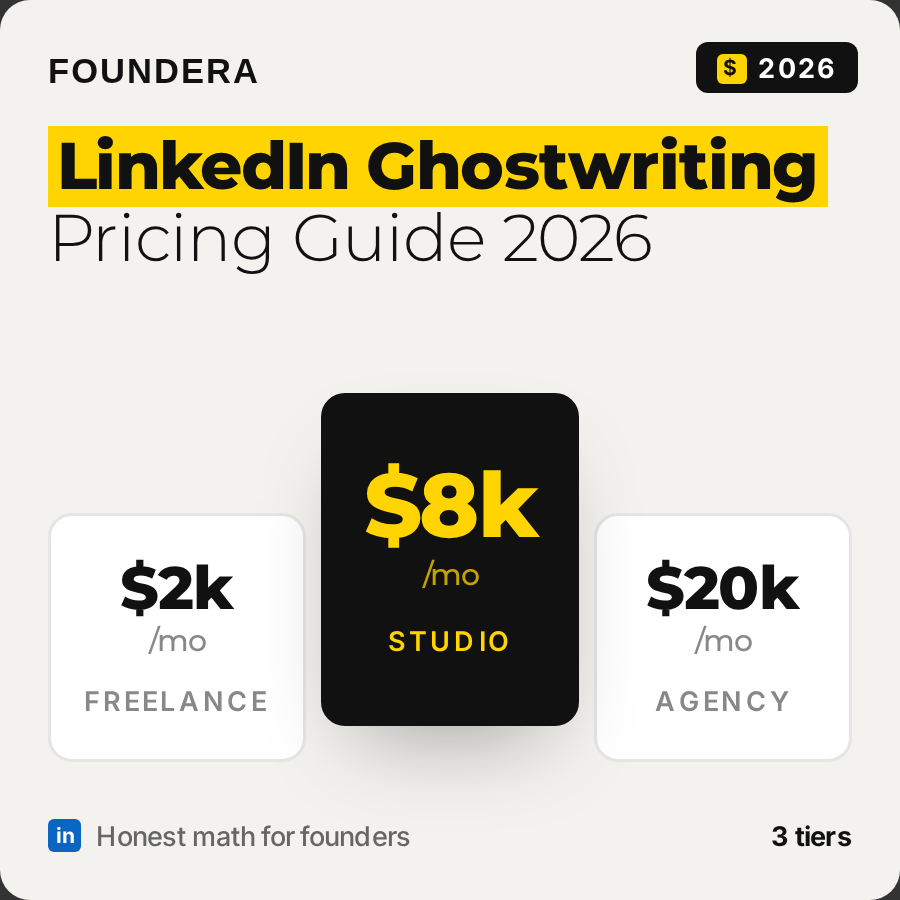
Pricing Ranges (2026)
- Freelance solo writer: $500–$2,000/month (high variance, high management burden)
- Boutique agencies: $3,000–$10,000/month (vetted, professional, ongoing support)
- Premium agencies: $10,000–$20,000+/month (strategy, LinkedIn newsletter, brand positioning)
What's included typically varies:
- 12-20 posts per month (most common)
- Weekly approval calls
- Monthly strategy review
- Profile optimization
- Performance tracking
Contract Terms to Negotiate
- Trial period: 30 days, money-back if not satisfied
- Commitment: 3-month minimum (you need time for momentum to build)
- Cancellation: 30 days notice, no penalty after the initial term
- Deliverables: Specify posts per month, approval turnaround, revision rounds
- IP: Confirm you own all content (you always should)
- NDA: The writer should sign an NDA protecting your business information
Red Flags in Contracts
- Non-compete clause (they can't write for competitors) — fair, but watch the scope
- Long lock-in (6+ month contracts with penalties) — pass
- Ownership ambiguity ("We own the posts unless...") — insist you own everything
- No revision guarantee ("Final after one draft") — this is a red flag
Managing the Ongoing Relationship
After you've onboarded your ghostwriter, here's how to make the relationship work:
1. Weekly Submission and Approval (30 min)
Monday/Tuesday: Writer submits 3-5 draft posts
Tuesday/Wednesday: You review and approve or request changes
Thursday-Monday: Posts are scheduled and published
2. Monthly Strategy Call (60 min)
First Friday of the month, discuss:
- Metrics from the past month (engagement, DM inquiries, profile views)
- Which topics resonated most
- What to adjust for next month
- Any strategic pivots (new market, product launch, etc.)
3. Show Up in the Comments
Your writer creates the posts, but you own the relationships. Respond to comments thoughtfully. Your ghost writer shouldn't be responding to comments as "you."
4. Give Specific Feedback
Not: "I don't like this."
Yes: "This feels too sales-y. I want more of my actual perspective here. Earlier versions sounded more like me."
5. Share What's Working
Tell your writer when you get inbound: "Got three DMs from this post topic." This helps them understand what resonates with your audience.
6. Quarterly Business Review
Every 3 months, take a step back and assess:
- Is the partnership still working?
- Are we hitting our engagement targets?
- Do you still like the voice and content quality?
- Any changes needed for the next quarter?
When to Switch Ghostwriters
Most founder-writer relationships should last 6+ months before you make a switch (momentum takes time). But there are legitimate reasons to part ways:
Good Reasons to Switch
- Quality decline: The posts that felt authentic months ago now feel generic
- Industry changes: Your writer doesn't understand your new market pivot
- Engagement stalls: After 3-4 months of consistent posting, engagement isn't improving
- Life happens: Your writer moves on or can't commit
Bad Reasons to Switch (Common Mistakes)
- One slow week of engagement: Engagement isn't linear. Don't panic if one week is slow
- You're impatient: Results take 3-6 months to compound. If you've only been 4 weeks in, give it more time
- You want to try a "cheaper" option: You'll likely get lower quality. Stay with what's working
When You Switch
- Give 30 days notice (per contract)
- Collect all posts and performance data from your previous writer
- New writer needs 2-3 weeks to capture your voice (expect slower output during transition)
- Don't abandon posting during the switch; your audience expects consistency
RFP Template and Hiring Checklist
Use this RFP template when reaching out to potential ghostwriters.
Subject: LinkedIn Ghostwriting RFP – [Company Name]
Hi [Name],
We're looking for a LinkedIn ghostwriter to help build my personal brand and thought leadership in [industry]. Here's what we're looking for:
About Our Needs
Content Frequency: 3-5 posts per week
Topics: [List 5-7 content pillars]
Audience: [CTOs, VPs of Security, DevOps engineers, etc.]
Budget: $[X]-$[Y] per month
Timeline: Starting [date], 3-month initial commitment
What We'll Evaluate
- Your experience writing for founders in [industry]
- Samples from 3+ clients (showing different voices)
- Your process for voice matching
- Your understanding of LinkedIn's algorithm and what performs
- Your availability and responsiveness
Next Steps
If interested, please send:
- 2-3 paragraphs about your background and approach
- Links or samples from 3+ clients (anonymized if needed)
- A 15-min call this week to discuss fit
Hiring Checklist
Use this checklist to evaluate your top 3-5 candidates:
- [ ] Portfolio shows different voices across clients
- [ ] Experience in my industry (or adjacent)
- [ ] Clear, detailed process for voice capture
- [ ] Offers trial period or satisfaction guarantee
- [ ] Available for 30-min weekly calls
- [ ] Reasonable pricing ($1,500–$7,000/month for quality)
- [ ] Professional communication and organized
- [ ] Asks good questions before starting
- [ ] Contract terms are fair (30-day cancellation, you own IP)
FAQ: Hiring Process Questions
Q: Can I hire a ghostwriter part-time or as a contractor?
A: Yes. Most ghostwriters are contractors (1099 in the US, or equivalent). Part-time is possible, but quality suffers if they're juggling multiple clients. For your own brand, insist on a dedicated arrangement or find someone else.
Q: What if I can't afford $3,000+ per month?
A: Start with a freelancer at $500–$1,000/month and be prepared to do heavy management (clear feedback, regular calls). Or commit to writing 2 posts per week yourself and hire help for 1 post per week ($1,000–$1,500/month).
Q: How much time do I need to invest?
A: 30 minutes per week for approval + 30-60 minutes per month for strategy = 2-3 hours per month. That's it.
Q: What if we disagree on a post's direction?
A: Good ghostwriters expect this. You say "This doesn't feel right," and they ask clarifying questions: "What about this angle? What if we led with this example instead?" Collaboration, not resistance, is the hallmark of a professional.
Q: Can I hire my internal marketing person to ghost-write for me?
A: Yes, but they'll need training in voice matching and LinkedIn's format. Most internal marketers write for the brand, not a person. You'll need to brief them on authenticity and personal perspective.
Q: What happens to the content if I stop working with my ghostwriter?
A: You own it. All posts are yours. You can keep posting them, republish them, reference them. The writer has no claim to the work.
Q: Should I disclose that I have a ghostwriter?
A: You don't need to. But you can if you want (e.g., "I work with a writer to help scale my content"). LinkedIn doesn't forbid ghostwriting. Many founders do it. The transparency vs. privacy call is yours.
--
Ready to hire? Use the RFP template and checklist above to vet candidates. Run a 6-week trial. Make the decision. Then commit and let the content compound over 6+ months.
About the Author
Ron Fybish is the founder of Foundera, a LinkedIn ghostwriting studio for deep-tech founders in cybersecurity, AI, DevOps, and cloud. He works with technical CEOs, CPOs, and CROs to translate their daily thinking into authentic LinkedIn content that builds pipeline, attracts talent, and compounds credibility — without taking up their calendar.
See also:
- LinkedIn Ghostwriter for CEOs: When and Why to Hire
- LinkedIn Ghostwriting Pricing Guide 2026: What You'll Pay and What's Included
- Founder-Led LinkedIn Growth: Building Authentic Thought Leadership at Scale