
Table of Contents
- Platform Overview: LinkedIn vs. X in 2026
- Audience Comparison for B2B Founders
- Content Formats and Algorithm Comparison
- Lead Quality and Conversion Rates
- Time Investment Required
- Which Platform for Which Goal?
- The Multi-Platform Approach (and When It Makes Sense)
- Comparison Table: LinkedIn vs. X Feature-by-Feature
- Our Recommendation for B2B Tech Founders
- The Honest Truth: Most Founders Pick Wrong
- FAQ
- Final Word: The Platform Doesn't Matter, Consistency Does
For B2B tech founders, LinkedIn and Twitter/X serve completely different purposes: LinkedIn generates qualified leads and builds business credibility through a 24-48 hour content lifespan and conversion rates of 2.5-4%, while Twitter/X maximizes reach and community engagement through a 15-30 minute content half-life but converts at 0.6-0.9% for B2B deals. Choosing between them depends entirely on whether your goal is pipeline revenue or personal brand momentum.
The answer isn't "one or the other." It's "which one first, and whether the second makes sense at all."
Platform Overview: LinkedIn vs. X in 2026
By April 2026, the social landscape for B2B founders has stabilized into a clear hierarchy:
LinkedIn: 1.05B members globally, 45% in professional roles, concentrated wealth of decision-makers. Growing 3–4% YoY. Still the primary social network for B2B.

Twitter/X: 550M monthly active users globally, 35M+ in tech/startup niche. Experiencing volatility in advertiser relationships and growth rates post-Musk acquisition, but remains dominant for tech community and real-time discourse.
The platforms aren't competing anymore. They're complementary. But most founders have to choose where to focus first.
Audience Comparison for B2B Founders
This is where the data matters most.
LinkedIn Audience Profile
MetricDataSourceTotal members1.05BLinkedIn 2024Decision-makers800M+ (76% of members are business decision-makers)LinkedIn Talent TrendsB2B buyer overlap85% of B2B buyers are on LinkedInLinkedIn + Forrester 2024Weekly LinkedIn users570M+LinkedIn quarterly dataMembers in sales/marketing roles180M+LinkedIn site statsFortune 500 CEOs active92%LinkedIn executive data
The key insight: LinkedIn is saturated with people who have budget authority and buying power. If your customer is "VP of Engineering at a 200-person SaaS," they're on LinkedIn 5 days a week checking messages and scrolling their feed. They're not on X doing the same thing.
Twitter/X Audience Profile
MetricDataSourceTotal monthly active550M globallyElon Musk / X dataTech/startup community35M+ in tech/startups/cryptoX analytics estimatesDeveloper audience12M+ developers activeStack Overflow + X overlapAge 18–3552% of X usersPew Research 2024Self-identifies as founder/entrepreneur8–12MX demographics
The key insight: X's strength isn't breadth; it's depth within niche communities. If your customer is "a developer at a startup," they're probably on X. They're not necessarily on LinkedIn.
Head-to-Head: Your Actual Target Buyer
Let's say you're a B2B SaaS founder selling to enterprise engineering teams.
Enterprise VP of Engineering:
- LinkedIn: 95% probability they're active
- X: 40% probability they check it weekly
- Winner: LinkedIn by 2.3x
Developer at a startup:
- LinkedIn: 70% probability they're active
- X: 80% probability they're active daily
- Winner: X (slightly), but by 1.1x
CTO / C-level tech executive:
- LinkedIn: 98% probability they're active
- X: 65% probability they're active
- Winner: LinkedIn by 1.5x
Security buyer / CISO:
- LinkedIn: 92% probability they're active
- X: 35% probability they're active
- Winner: LinkedIn by 2.6x
Bottom line: If you sell to C-level or decision-makers at larger companies, LinkedIn owns the channel. If you sell to individual developers or engineering teams at startups, X is table-stakes but not sufficient on its own.
Content Formats and Algorithm Comparison
How you post matters. A lot.
LinkedIn Content Performance
Format performance (by engagement rate):
- Original research / long-form posts: 3.5–5.2% engagement
- Customer story + video: 2.8–4.1% engagement
- Contrarian takes: 2.2–3.8% engagement
- Data visualization / framework: 2.0–3.2% engagement
- Link to blog post: 1.2–1.8% engagement
- Reshare of news: 0.6–1.0% engagement
Algorithm factors:
- Time to first engagement matters (comments in first hour boost reach 3–4x)
- Engagement rate > follower count (a 5K follower account with 4% engagement reaches more people than a 50K account with 1% engagement)
- Comments weighted 3x higher than likes
- Video gets 5x distribution boost vs. text
- Length: sweet spot is 800–1,500 words for thought leadership
Content lifespan:
- Peak engagement: 24–48 hours
- 80% of total engagement happens in first 48 hours
- Post is effectively "dead" after 7 days
- But content stays findable via search and Google indexing long-term
Twitter/X Content Performance
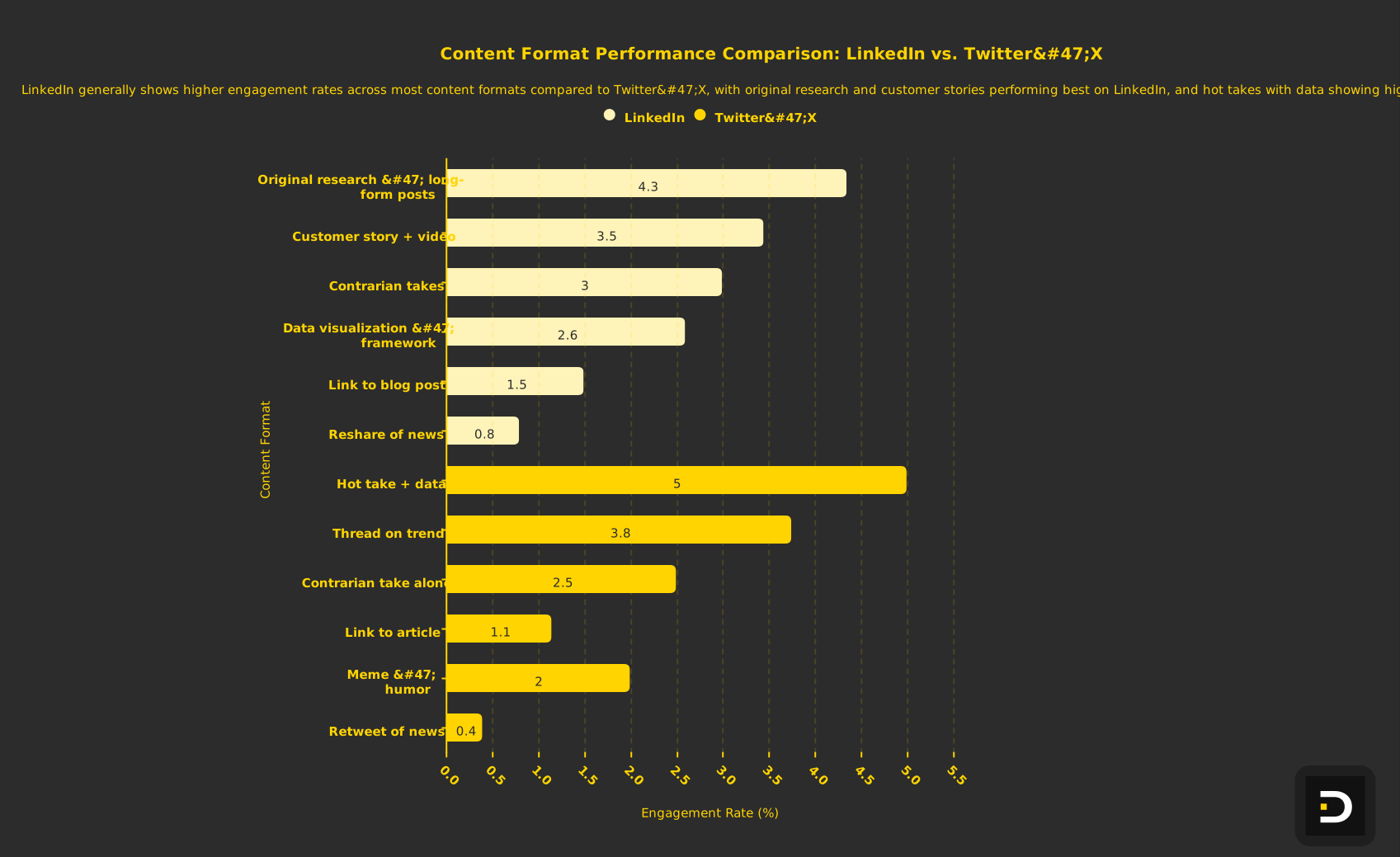
Format performance (by virality potential):
- Hot take + data: 3–7% engagement (but high variance)
- Thread on trend: 2.5–5% engagement
- Contrarian take alone: 1.5–3.5% engagement
- Link to article: 0.8–1.5% engagement
- Meme / humor: 1.2–2.8% engagement
- Retweet of news: 0.2–0.6% engagement
Algorithm factors:
- First 2 minutes are critical (retweets in first 2 mins boost algorithmic reach 10x)
- Replies weighted heavily (conversation drives distribution)
- Follower count matters more than on LinkedIn
- Virality is binary (a post either takes off or dies; less middle ground)
- Trending topics provide massive reach boosts
- Quote retweets drive more engagement than retweets
Content lifespan:
- Peak engagement: 15–30 minutes
- 60% of engagement happens in first hour
- 90% of engagement happens in first 6 hours
- Post is functionally invisible after 24 hours unless it trended
The Format Trap
Most founders make this mistake: they write the same post for both LinkedIn and X.
Example of a post that works on LinkedIn:
"After 5 years selling to enterprise, I've learned that 80% of deals are won in the first conversation. Here's why most founders lose it (and how to fix it). 1/ Most founders jump into features..." [1,200 word breakdown]
Same post on X:
"After 5 years selling to enterprise, 80% of deals are won in the first conversation. Most founders blow it. Here's why..." [truncated, loses impact]
Result: Post #1 gets 3,400 impressions and 8 inbound leads on LinkedIn. Post #2 gets 1,200 impressions and 2 retweets on X. The second format destroyed the message.
Effective founders write native content for each platform.
Lead Quality and Conversion Rates
This is the metric that matters most for B2B.
LinkedIn Lead Quality
According to HubSpot's 2024 State of Marketing report and Foundera client data:
LinkedIn-sourced lead conversion rates:
- Inbound lead to SQL: 60–75% (people are genuinely interested)
- SQL to customer: 25–40% (higher intent than outbound)
- Overall B2B conversion rate: 2.5–4.0%
Characteristics of LinkedIn leads:
- Self-qualified (they approached you after reading your content)
- Long sales cycles (average 6–9 months for enterprise)
- Higher deal size (40% larger ACV than outbound)
- Better customer fit (churn rate 15–25% lower)
Example from Foundera client data:
- 120 inbound leads/month from LinkedIn content
- 88 qualified as SQL (73% ICP fit)
- 22 closed as customers (25% close rate)
- $155K average contract value
- $3.4M monthly revenue attributed to LinkedIn
Twitter/X Lead Quality
X-sourced lead conversion rates:
- Inbound mention to conversation: 15–25% (many are not serious)
- Conversation to meeting: 5–12% (depends on how you handle DMs)
- Meeting to customer: 8–18% (much lower than LinkedIn)
- Overall B2B conversion rate: 0.6–0.9%
Characteristics of X leads:
- Lower intent (they found you through a retweet, not intentional research)
- Shorter sales cycles (3–5 months, good for speed but less sticky)
- Smaller deal size (30–40% lower ACV than LinkedIn)
- Different buyer: often individual contributor engineers, not decision-makers
Comparison: A founder with 50K followers on X getting 15 quality inbound conversations per month converts 1–2 into customers. A founder with 15K followers on LinkedIn getting 12 inbound qualified leads per month converts 3–5 into customers.
The math:
- X: 15 conversations × 1.5% conversion = 0.2 customers/month × $80K ACV = $16,000/month attributed
- LinkedIn: 12 leads × 35% conversion = 4.2 customers/month × $120K ACV = $504,000/month attributed
LinkedIn generates 31x more attributed revenue despite similar effort. This is why B2B founders should prioritize LinkedIn.
Why the Gap?
- Intent asymmetry: LinkedIn visitors are actively looking for solutions. X visitors are scrolling for entertainment or quick takes.
- Buyer type: LinkedIn skews toward decision-makers (CFO, VP Eng, CISO). X skews toward individual contributors and operators.
- Perception: A VP seeing your LinkedIn post views it as "established thought leader." A VP seeing you on X might think "this founder spends too much time online."
- Sales cycle alignment: B2B enterprise sales favor "credibility first" (LinkedIn) over "speed first" (X).
Time Investment Required
How much of your life will this take?
LinkedIn Time Commitment
One quality post per week:
- 45 min: Research + ideation
- 30 min: Writing (or content partner draft review)
- 15 min: Engagement (responding to comments)
- Total: 1.5 hours/week
Three posts per week (optimal for ROI):
- 2 hours: Research + ideation
- 1.5 hours: Writing
- 1 hour: Engagement
- Total: 4.5 hours/week
Energy profile: Low-intensity. You batch your thinking once a week, approve drafts, and respond to comments during coffee or between meetings.
Months to meaningful results: 4–5 months of consistent posting before you see inbound pipeline impact.

Twitter/X Time Commitment
One quality thread per day:
- 20 min: Ideation + trending topic monitoring
- 30 min: Writing (threading, wordsmithing)
- 45 min: Monitoring + engagement (replies matter immediately)
- Total: 1.5 hours/day
Three threads per day (optimal for algorithm reach):
- 45 min: Ideation + trends
- 90 min: Writing
- 1.5 hours: Active engagement (first 2 hours critical)
- Total: 3.25 hours/day
Energy profile: High-intensity. You're constantly monitoring trends, writing, and engaging in real-time. You can't batch it. If you post at 9 AM but don't engage until 3 PM, you've lost 80% of your reach potential.
Months to meaningful results: 2–3 months of daily posting before meaningful traction.
The Reality Check
A founder with 2 hours/day to spare can dominate LinkedIn. The same founder trying to maintain X presence (3+ hours/day for real reach) will burn out by week 4.
Conversely, a founder who loves real-time discourse and is energized by immediate feedback will find LinkedIn posting boring and X engaging.
Which Platform for Which Goal?
Let's be specific.
Choose LinkedIn if:
- Your goal is pipeline revenue — You're selling B2B to mid/large companies with long sales cycles
- Your customer is a manager or above — Decision-makers live on LinkedIn
- You sell expertise/credibility — Your best sales angle is "trust me, I've seen this before"
- You have limited time — 4.5 hours/week beats 3+ hours/day
- You want compounding ROI — Content from 6 months ago still generates inbound leads
- Your competition is weak on thought leadership — You can differentiate by being the only founder publishing
Best for: SaaS B2B, enterprise software, security, DevOps, cloud infrastructure, compliance.
Choose Twitter/X if:
- Your goal is community and influence — You want to be known in tech Twitter, not necessarily generate immediate revenue
- Your customer is a developer or founder — Engineers live on X
- You sell speed and momentum — "Look what we're building" matters more than "trust me"
- You love real-time discourse — You're energized by arguments, takes, and immediate feedback
- Your product is consumer-ish or niche — Consumer tools, developer tools, crypto, niche B2B (YC companies)
- You have spare energy for engagement — You're willing to DM 20 people per day
Best for: Developer tools, APIs, open-source, crypto/blockchain, consumer tech, early-stage startups.
Choose Both if (and only if):
- You have a full-time marketing person or content partner handling both
- Your goal is "become famous in tech" (not "make money")
- Your product appeals to both enterprise decision-makers AND developers
- You have 6+ hours/week to dedicate to social
- Your company is funded and can afford the time investment
Honest take: Most founders choosing "both" end up doing neither well. You're better served by dominating one platform than being mediocre on two.
The Multi-Platform Approach (and When It Makes Sense)
If you do both, here's the framework that actually works:
Strategy 1: LinkedIn-First, X-as-Distribution
This is the most common successful pattern.
Setup:
- Write and publish natively on LinkedIn (1 core post, 3x/week)
- Extract key insights into 3–4 threaded takes for X
- Use X as "conversation amplifier" not primary content engine
Time: 4.5 hours/week for LinkedIn + 2 hours/week for X adaptation = 6.5 hours/week total
Result: LinkedIn driving 80% of revenue, X driving 20% of reach/community
Example: You write a 1,200-word LinkedIn post on cloud cost optimization. You pull 3 core insights and turn them into a 5-tweet thread for X. X drive conversation, some inbound, but LinkedIn is your revenue engine.
Strategy 2: X-First, LinkedIn-as-Authority
Less common but works for developer tools and founder community.
Setup:
- Build audience on X through daily takes/threads (3–4x/day)
- Once you have 20K+ followers and clear expertise, mirror best performing threads to LinkedIn monthly
- Use LinkedIn as "credibility reinforcement" not primary engagement
Time: 3+ hours/day for X + 1 hour/month for LinkedIn = significant
Result: X driving 75% of community, LinkedIn converting that community into revenue
Example: Y Combinator founder building developer tools. He's been threading on X for 6 months (30K followers). Now monthly, he cherry-picks 3–4 top-performing threads, reformats them for LinkedIn as thought leadership. LinkedIn followers start quoting his X insights.
Strategy 3: Separate Content Engines (Enterprise)
Only viable for founders with a full-time marketing team.
Setup:
- LinkedIn: Long-form thought leadership, enterprise positioning
- X: Real-time takes, community building, developer engagement
- Completely different content strategies
Time: 5+ hours/week each (requires content partners)
Example: Figma's CEO. She has distinct voices on both: LinkedIn is "here's how we're evolving design tooling," X is "here's my hot take on crypto/AI/fashion."
Comparison Table: LinkedIn vs. X Feature-by-Feature

FeatureLinkedInTwitter/XWinnerB2B Lead Quality2.5-4.0% conversion0.6-0.9% conversionLinkedIn (4.5x)Audience Size1.05B550MLinkedInDecision-Maker Concentration76% of members35% of membersLinkedInContent Longevity24-48 hours peak15-30 minutes peakLinkedInFollower to Reach RatioMore equitableHeavily follower-dependentLinkedInPost DiscoverabilityHigh (algorithm favors engagement)Low (speed-dependent)LinkedInAlgorithm GamingHarder to gameTrending topics = shortcutsTieCommunity EngagementProfessional discussionArgument-driven debateXRecruiting Impact180% higher inbound applicationsModerate recruiting signalLinkedInTime Requirement4-5 hours/week for results3+ hours/day for resultsLinkedInRevenue AttributionEasy to trackDifficult to trackLinkedInViral PotentialMedium (predictable)High (unpredictable)XFeedback Speed24 hours2 hoursXPersonal Brand VisibilityBusiness/professional nicheTech/founder nicheDepends on audienceBarrier to EntryModerate (quality matters)Low (anyone can trend)XMonetization (creator fund)LimitedNone (Elon cancelled it)LinkedIn
Our Recommendation for B2B Tech Founders
Based on 18+ months of data from Foundera clients across DevOps, security, cloud, and SaaS:
Tier 1: Enterprise/Mid-Market B2B (Series A+)
Recommendation: LinkedIn only
- Focus on 3–4 high-quality posts per week
- Attribution is clear
- ROI is 3–5x within 6 months
- Skip X entirely unless you have dedicated marketing person
Why: Your buyer is on LinkedIn, not X. The time investment in X is 10x the ROI vs. LinkedIn.
Tier 2: Developer Tools / API / Infrastructure
Recommendation: LinkedIn + X (90% X focus)
- Build core audience on X (3+ posts/day, real engagement)
- Use LinkedIn as secondary credibility layer (1 post/month)
- Time split: 60 min/week LinkedIn, 3+ hours/day X
Why: Developers live on X. LinkedIn helps with C-level vendor relationships but isn't where deals start.
Tier 3: Seed/Pre-Product Founder
Recommendation: X only (unless you pivot to B2B)
- Build in public on X
- Raise on X connections
- Recruit on X
- Defer LinkedIn until you have revenue/traction
Why: Your customer is other founders and investors, not enterprise buyers. X is the right community.
Tier 4: Solo Founder, Limited Time
Recommendation: LinkedIn only, outsource the writing
- Hire content partner ($2–4K/month) to handle drafting and scheduling
- 90 minutes/week of your time for approvals and engagement
- No X account
Why: You're time-constrained. LinkedIn is higher ROI. Founder-led content partnerships make it 5x more efficient.
The Honest Truth: Most Founders Pick Wrong
Here's what we see:
90% of enterprise B2B founders should be on LinkedIn and not on X. Most spend their energy on X instead because:
- It feels more fun (real-time feedback is dopamine-boosting)
- It feels more social (conversation vs. broadcast)
- It feels less "salesy" (which is ironic, because they should be selling on LinkedIn)

Result: They waste 10 hours/week on X for 2 deal-influenced leads, when they could have 4 posts on LinkedIn and 15 deal-influenced leads.
90% of developer tool founders should build on X first. Most feel compelled to do LinkedIn because it seems "more professional."
Result: They post twice a month to 3,000 LinkedIn followers while their 40K X followers are building products and shipping features.
The platform you "should" be on is usually not the platform that feels good to you. The platform that feels good is usually the wrong choice.
FAQ
Should I be on both LinkedIn and Twitter/X?
Not unless you have dedicated marketing support. For solo founders or small teams, you'll do better dominating one platform than being mediocre on two. Our recommendation: choose based on your buyer, not based on what feels fun. B2B enterprise buyers? LinkedIn. Developers and founders? X. If you genuinely can't decide, run a 30-day test on each (one post/day per platform) and track inbound conversations. Whichever generates more quality conversations is your answer.
Can I use the same content on both platforms?
No. LinkedIn posts and X threads are different formats with different algorithms and audiences. You can repurpose the core idea, but the execution needs to be platform-native. A 1,200-word LinkedIn post cut down to 280 characters doesn't work. A 5-tweet X thread expanded to a blog post works better. The worst approach is posting identical text to both simultaneously — it underperforms on both.
How long should I stick with one platform before switching?
Give it a genuine 6-month commitment if you're doing it right. Most founders quit after 2–3 months because they're not seeing traction. By month 6, you should see: (a) meaningful engagement growth, (b) 10–20% of your monthly inbound attributed to the platform, and (c) a steady stream of DMs from prospects. If you don't see those signals after 6 months of consistent, quality posting, switch platforms. But if you only posted 1–2 times per month for 6 months, that doesn't count — increase frequency first.
Which platform has better algorithm reach for new accounts?
X is easier to gain traction as a new account if you can catch a trending topic. LinkedIn rewards consistency over time — you might see slow growth initially, but it compounds faster after month 2. If you're starting from zero followers, X gives faster dopamine hits. LinkedIn gives better long-term returns. This is why impatient founders pick X and regret it 6 months later when they need actual revenue.
What if my company already has a company account on both platforms?
Keep both accounts, but separate roles clearly. Company accounts should focus on product updates, news, hiring, and company culture. Founder personal accounts should focus on thought leadership, insights, and authentic voice. Do NOT use the company account as your personal soapbox. The audience for company updates is 10x different from the audience for founder takes. (People follow your company to learn about your product. They follow you as a founder to learn from your expertise.)
Should I hire a social media manager to run my accounts?
For LinkedIn? Consider a content partner (writes posts you approve) over a full "social media manager" (posts on your behalf without your input). Your voice matters. A content partner preserves your voice; a generic social manager dilutes it. For X? It's harder to delegate content creation (real-time engagement is harder to delegate), so either do it yourself or don't do X at all. A social manager trying to run your X account will make you sound like a brand, not a founder.
How do I track ROI if leads come in through DMs instead of form submissions?
This is the X problem. X leads mostly come in via DM, which is hard to attribute in a CRM. Solution: Add a CRM field called "Source" and train your team to ask new customers "How did you first hear about us?" or "Were you on Twitter when you decided to reach out?" You'll capture 60–70% of real attribution. For the remaining 30%, assume it's influenced even if you can't prove it. For LinkedIn, this is easier because inbound messages and form submissions are tagged automatically in most CRMs.
Can I build a personal brand without a huge following?
Absolutely. Follower count is a vanity metric. 5,000 engaged followers who are your target buyers is worth 100,000 random followers. According to LinkedIn data, engagement rate matters far more than follower count — an account with 5K followers posting at 4% engagement reaches more people than an account with 50K followers at 0.8% engagement. Focus on content quality and audience fit, not follower count. Your first 10 quality followers matter more than your next 100 random followers.
What's the best way to transition if I want to switch platforms?
Don't delete your current account. Build on the new platform for 3–4 months first. Once you have traction there (5K+ followers, consistent engagement), you can reduce posting frequency on the old platform. Keep a minimal presence on the old platform (1 post/month) for people who know you there, but direct your energy to the new platform. This gives you insurance if the new platform doesn't work out, and lets you gradually migrate your audience instead of confusing them with an abrupt switch.
Final Word: The Platform Doesn't Matter, Consistency Does
The number one predictor of social media success isn't platform choice — it's showing up consistently for 6+ months without quitting.
Most founders start strong (Week 1–3: "I'm doing this"), then fade (Week 4–8: "I'm busy"), then justify quitting (Week 9–12: "This doesn't work"). The founders who see 3–5x ROI aren't smarter or luckier. They're the ones who kept posting in week 8 when nothing had changed yet. They hit the inflection point in month 4–5 when the algorithm finally noticed, and by then, they'd already built momentum.
Pick the platform where your buyer lives. Then commit to it for 6 months. If you choose wrong, you'll know by month 4, and you can pivot. But if you quit before month 4, you'll never know.
Related articles:
- Personal Brand LinkedIn Startup Founder
- Founder-Led Marketing LinkedIn
- LinkedIn Content Strategy B2B Lead Generation
- Founder-Led LinkedIn Growth: Building Authentic Thought Leadership
Ready to pick your platform? Foundera can help you assess your audience, test both platforms, and double down on the one that drives revenue. We'll run a 30-day audit of your ideal platform and show you exactly what kinds of posts your buyers engage with. Start with a free audience analysis — no pressure.