
Table of Contents
- Why Personal Branding Matters for Startup Founders
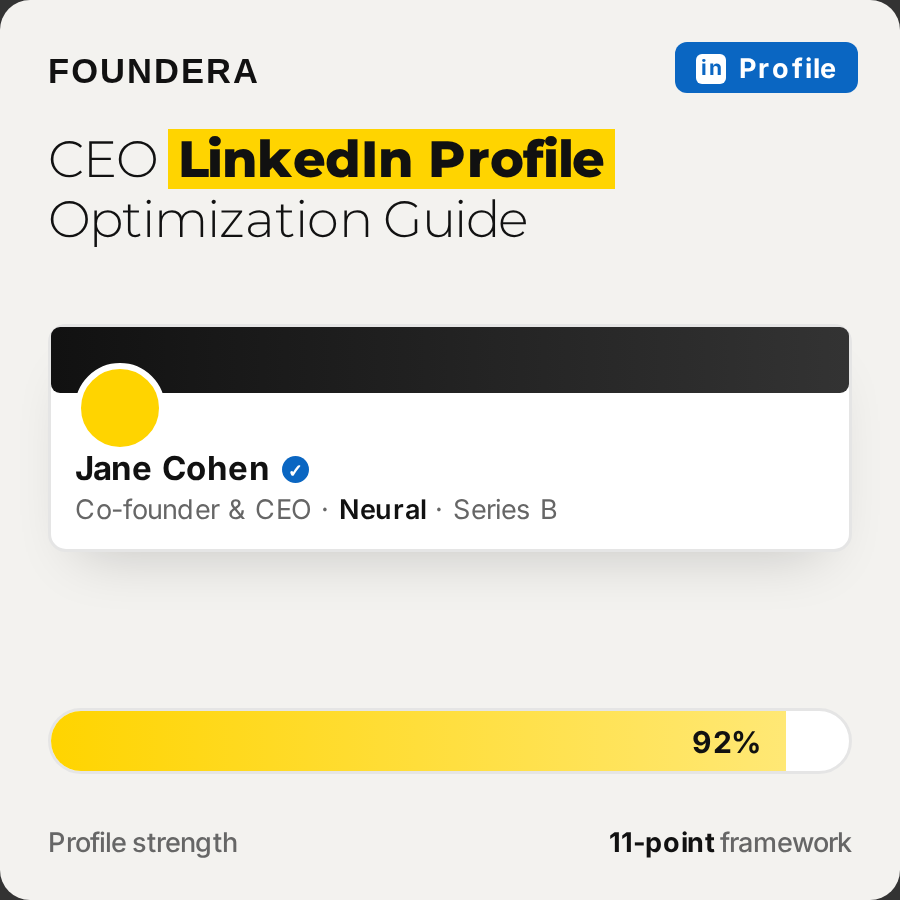
- Step 1: Optimize Your LinkedIn Profile
- Step 2: Define Your Content Pillars
- Step 3: Create Your First 30 Days of Content
- Step 4: Build Engagement Loops
- Step 5: Measure What Matters
- The DIY vs. Agency Decision
- FAQ
- Step 6: 90-Day Momentum Check
- CTA
A strong personal brand on LinkedIn accelerates everything: fundraising, hiring, business development, and strategic partnerships. Founders with active, authentic LinkedIn presence raise approximately 23% more in funding rounds, with 77% of VCs researching founder LinkedIn profiles before meetings (First Round Capital). This step-by-step guide covers profile optimization, content pillars, 30-day launch strategy, engagement loops, and measurement — whether you're building solo or with founder-led content partnerships support.
Why Personal Branding Matters for Startup Founders
The Data
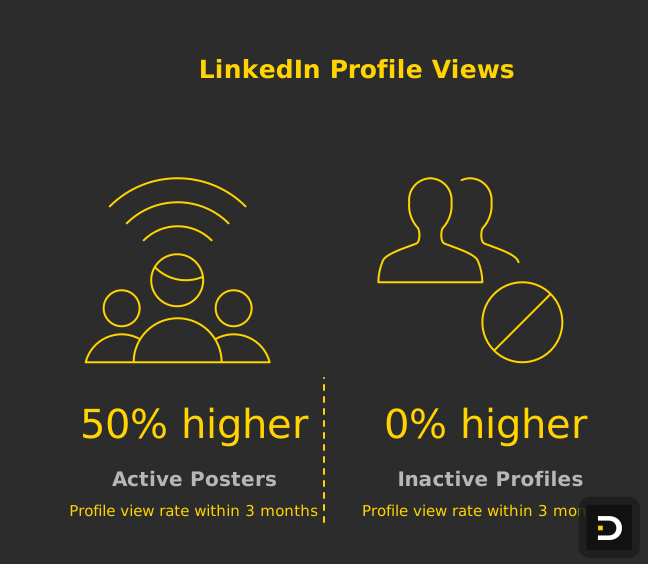
According to First Round Capital research, 77% of VCs check founder LinkedIn before taking meetings. According to LinkedIn's own data, founders with regular posting activity (3–5x/week) see 50% higher profile view rates within 3 months compared to inactive profiles.
Translation: Your LinkedIn presence is often your first impression on investors, partners, and talent before they meet you in person.
Beyond Fundraising
Personal brand benefits compound across three channels:
1. Capital: VCs use LinkedIn to pre-screen founders. A thoughtful profile with demonstrated expertise shortens diligence and increases conviction.
2. Hiring: Technical talent researches founders. A strong LinkedIn presence signals leadership credibility and attracts better candidates. (One founder we know reported 70% of inbound candidates mentioned his LinkedIn presence in conversations.)
3. Business Development: Customers and partners trust founders they've "researched." LinkedIn gives you a mechanism to build trust before outreach.
4. Community: Other founders, investors, and collaborators find you through content. Inbound opportunities replace cold outreach.
The Compounding Effect
Unlike a blog or newsletter, LinkedIn is:
- Searchable (investors search "AI security founder" and find you)
- Social (comments and replies create conversation, not monologue)
- Trust-building (your network endorses you; their endorsement transfers credibility)
- Algorithmic (consistent posting trains LinkedIn to show your content to relevant audiences)
Most founders see momentum shift around week 8–12 of consistent posting (3–5x/week). By month 6, inbound feels frequent enough that you're actually declining opportunities.
Step 1: Optimize Your LinkedIn Profile
Your profile is your digital headquarters. It needs to work in 10 seconds.
Profile Photo
- Requirement: Professional headshot (studio-quality). This matters more than you think.
- Details: Clear face, neutral background, good lighting, genuine smile. Not a meme. Not a headshot from 2015.
- Time to fix: 1–2 hours (find a local photographer, $150–$300)
- Why: Profile views increase 21% with a professional photo (LinkedIn data). Investors notice.
Headline (120 characters)
Don't: "CEO at ACME | AI | Founder | Stanford"
Do: "Building AI-powered supply chain security | Formerly [Prior Role at Notable Company]"
Why: Use keywords (AI, security, founder) that investors search for. Include what you're building, not just your title.
Template: "[What you're building] | Founder at [Company] | Previously [Notable company/achievement]"
About Section (2,600 characters)
This is where your voice emerges. Spend time here.
Structure:
- Hook (1–2 sentences): What problem are you solving? Why does it matter?
- Origin story (2–3 sentences): Why did you start this? What was the "aha"?
- What you're building (2–3 sentences): Product, vision, target customer.
- Your approach (1–2 sentences): What's unique about how you solve this?
- What's next (1 sentence): Hiring? Raise? Public launch?
- CTA (1 sentence): "If you're building in [space], let's talk" or "Open to intros in [domain]"
Example: "I'm building the first unified vulnerability detection platform for modern supply chains. Most supply chains still use 1990s-era monitoring tools. They miss 60% of vulnerabilities.
Started Acme after a supply chain attack cost my last company $2M to remediate. I realized the tooling was fundamentally broken.
Now leading a team of 6 (all ex-Apple, ex-Microsoft) to ship a platform that finds vulnerabilities in real-time across 100K+ suppliers. We're processing 5M+ signals/day from our customer base.
Raised $1.5M seed in 2025. Currently hiring engineer #7 and exploring Series A conversations.
If you're in supply chain risk or SecOps, let's grab coffee."
Experience Section
- Rewrite each role to highlight outcomes, not duties
- Bad: "Responsible for product development and team management"
- Good: "Built product roadmap that drove 3x MRR growth; scaled team from 2 to 8 engineers"
- Include metrics wherever possible (growth %, team size, revenue impact)
Skills & Endorsements
Add 10–15 relevant skills (AI, Supply Chain Security, Startups, etc.). Don't worry about endorsements; they accrue naturally.
Featured Section
Add links to:
- Your company homepage
- Recent press mentions
- Pitch deck or product video
- Podcast appearances or talks
- Best LinkedIn posts (after you start posting)
This section makes your profile a hub, not a dead-end.
LinkedIn URL
Customize your URL to: linkedin.com/in/your-name (not the default random string)
Open to Work (Optional)
If you're open to board roles, advisor positions, or founding opportunities, enable "Open to Work" and specify what you're looking for. Be specific (not just "open to interesting opportunities").
Step 2: Define Your Content Pillars
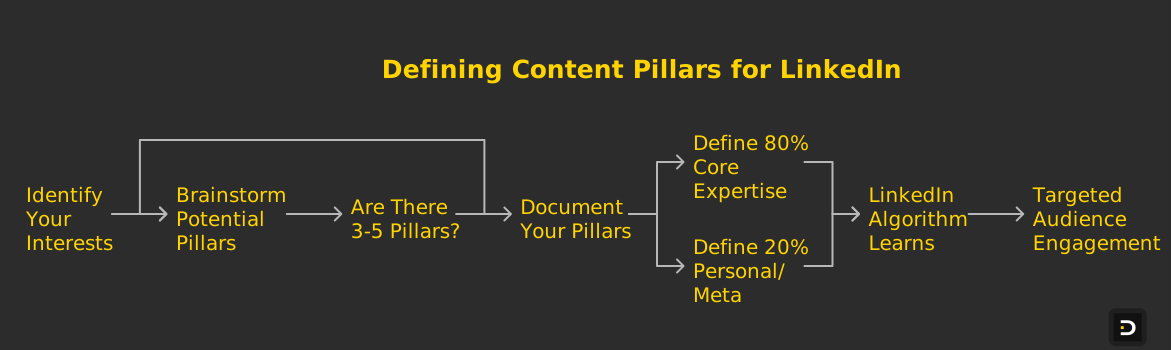
Content pillars are the 3–5 themes you'll write about repeatedly. They focus your voice and train LinkedIn's algorithm to find your audience.
How to Find Your Pillars
Ask yourself: What do I think about constantly? What have I learned the hard way? What problems do I see others solve poorly?
Example pillars for a supply chain security founder:
- Supply chain vulnerabilities (why they exist, how to find them, why vendors lie)
- Building under pressure (fast fundraising, hiring, shipping with small teams)
- Future of security tooling (generative AI in vulnerability detection, automation)
- Founding lessons (mistakes, failures, non-obvious learnings)
- Industry trends (regulations, investor behavior, market consolidation)
Why Pillars Matter
LinkedIn's algorithm rewards consistency. If you post randomly about AI, then supply chains, then startups, then culture, the algorithm doesn't know who to show your content to.
But if you post 80% about supply chains and 20% about founding lessons, LinkedIn learns: "this founder appeals to supply chain security people" — and shows your content to them specifically.
The 80/20 Split
- 80% Core expertise: Your domain (supply chain security, AI, DevOps, etc.)
- 20% Personal/meta: Founding lessons, team culture, "here's what I learned"
The personal stuff builds humanity and attracts other founders. The expertise stuff builds authority and attracts your actual customer/investor/talent base.
Pillar Documentation
Write down your 3–5 pillars and 2–3 sub-topics under each. This becomes your content backlog.
Example:
- Pillar: Supply Chain Vulnerabilities
- Subtopic: Why vendors hide breach history - Subtopic: The difference between pen tests and runtime detection - Subtopic: Compliance theater vs. actual security
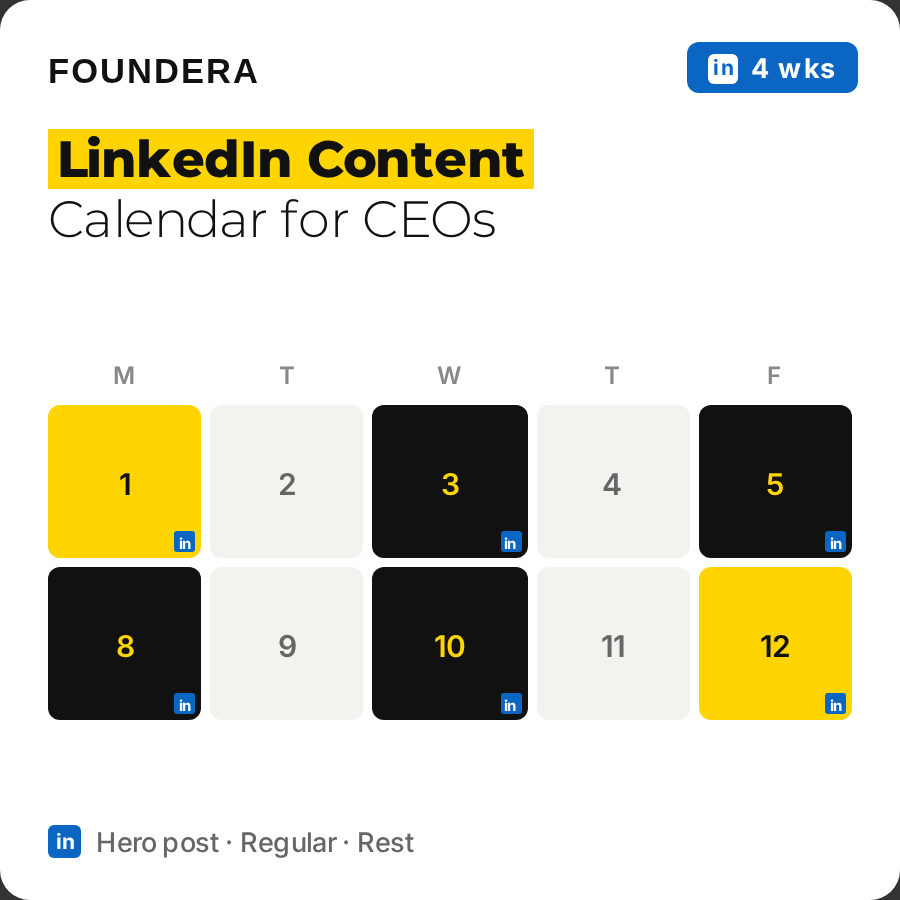
Step 3: Create Your First 30 Days of Content
You're not starting from zero followers. You have your existing network (1K–10K people, depending on background).
Your job in month 1 is to post consistently and establish rhythm, not go viral.
The 30-Day Content Calendar
Week 1: Introduction + Authority
- Post 1: "Here's what I'm building and why" (company origin story)
- Post 2: "One thing I got wrong when I started" (authentic failure story)
- Post 3: "The biggest misconception in [domain]" (expertise)
- Post 4: "Here's what we're hiring for" (signal of momentum)
- Post 5: "One framework that changed how I think about [problem]" (useful)
Week 2: Thought Leadership + Engagement
- Post 1: Thread on "5 things I learned in my first [time period]" (multi-part)
- Post 2: Data point from your space (e.g., "77% of supply chains still use 20-year-old tools")
- Post 3: Customer win story (without naming them: "One of our customers just prevented $5M breach")
- Post 4: Counter-intuitive opinion ("Everyone's wrong about [common belief]")
- Post 5: Market insight ("Watch for this trend in [space]")
Week 3: Community + Vulnerability
- Post 1: Question to your audience ("What's the hardest part of [problem]?")
- Post 2: Behind-the-scenes: "Building is hard" (struggling with hiring, shipping delays, etc.)
- Post 3: Lesson from hiring (what you look for, red flags, culture fit)
- Post 4: Forward-looking vision ("In 3 years, [this] will be table stakes")
- Post 5: Update on company progress (revenue, team size, customer wins)
Week 4: Consistency + Network
- Post 1: Recap a podcast you heard (thoughts + link)
- Post 2: Shout-out to team member (highlight their expertise)
- Post 3: "Things I was wrong about [in previous content]" (intellectual honesty)
- Post 4: Metrics and momentum ("We're approaching $X MRR")
- Post 5: Vision statement or annual theme
Content Format Guidelines
Title/Hook (5–10 words):
- "Why 90% of supply chains get hacked"
- "The biggest mistake I made as a founder"
- "What VCs don't understand about [space]"
Body (100–300 words):
- Start with a surprising stat or statement
- Explain the insight or story (2–3 paragraphs)
- End with a question or call-to-action ("What's your experience?")
- Use line breaks and whitespace (mobile readability)
- Avoid jargon; use simple words
- One main idea per post
Hashtags (3–5):
- #Startups, #SecurityEngineering, #Founders, #AI, plus 1–2 niche tags
CTA:
- "What's your take?"
- "Have you seen this?"
- "Let's connect if you're working on this"
Posting Schedule
Post 5x/week (Mon–Fri, roughly same time). The algorithm prefers consistency over virality.
- Tuesday–Thursday: Higher engagement expected
- Monday/Friday: Lower volume, but engagement/depth higher
- Optimal time: 8am–10am or 12pm–1pm in your timezone (when your network is online)
Use a scheduler (Buffer, Later, LinkedIn native scheduler) so posts go out even if you're busy.
Step 4: Build Engagement Loops
Posting is half the battle. Engagement is the other half.
When someone comments on your post, you have 6 hours to respond before the engagement momentum kills. This is where most founders fail.
The Engagement Loop
- You post (8am, e.g.)
- Your network comments (8:30am–10am)
- You respond thoughtfully (within 2 hours) ← This is critical
- More people comment seeing your reply
- Algorithm boosts post (more visibility)
- Post gets 200+ comments, thousands of views (if you did steps 3–5 right)
How to Respond to Comments
Good response:

- Directly addresses what they said (shows you read it)
- Adds new information (not just "thanks!")
- Asks a follow-up question (extends conversation)
- 1–2 sentences (respects comment thread length)
Example:
Comment: "This is how we solved it at [Company]"
Your response: "That's smart. Did you run into the issue where [specific problem]? We tried that approach but found it didn't scale past [threshold]."
Bad response:
- "Thanks!" (adds nothing)
- "Couldn't agree more!" (no substance)
- Ignores what they said and pivots to your agenda
Time Commitment
Genuine engagement requires 15–30 minutes per post in the first 6 hours:
- 2–3 minutes to respond to each comment
- 5–10 comments per post on average early on
- 5 posts/week
So roughly 90–150 minutes per week on engagement. Doable? Yes, but it's the piece most founders skip.
Engagement as Founder Development
Bonus: responding thoughtfully to comments teaches you things. You're crowdsourcing feedback, learning what resonates, finding experts in your space, and building relationships.
This is the opposite of shouting into the void.
Step 5: Measure What Matters
LinkedIn provides free analytics. Use them.
The Dashboard
Go to your profile → "Analytics" (top right) for:
- Profile views (weekly trend): Should go up 2–3x within 2 months
- Search appearances: How many times your name appears in searches
- Post engagement: Reactions, comments, shares per post
- Follower growth: New followers per week
Metrics That Matter
Week 1–2:
- Are people even seeing your posts? (Check impressions: aim for 500–1,000 per post minimum)
Week 3–8:

- Is engagement going up? (Comments per post should increase from 5 to 15+)
- Are profile views increasing? (Should be 2–3x higher than baseline)
Month 3+:
- Are you getting inbound DMs? (This is the signal that matters)
- What topics generate most discussion? (Double down on those)
- Are followers quality or vanity? (Check if they're in your target industry)
The Inbound Signal
The real measurement is inbound:
- Investor intros or meeting requests
- Recruiter or candidate outreach
- Customer or partnership inquiries
- Speaking invitations
- Media or podcast requests
By month 4–6 of consistent posting, you should see 2–3 inbound opportunities per month that trace back to LinkedIn. If not, your content might not be resonating with your actual audience.
Monthly Audit (30 minutes)
Once a month, take 30 minutes to:
- Screenshot your top 3 posts (what worked?)
- Identify which topics got most comments (pattern)
- Note which comments came from target audience (investors, customers, talent)
- Ask: "Am I talking to the right people, or just my friends?"
- Adjust next month's content accordingly
The DIY vs. Agency Decision
This is the fork in the road.
DIY (You Write It)
Pros:
- It's authentic (your voice, your takes)
- You own your thought process (great for clarity)
- No cost
- You're building writing muscle
Cons:
- Takes 3–5 hours per week (ideation, writing, editing, responding)
- Hard to maintain consistency when busy (fundraising, product crisis, etc.)
- Voice inconsistency if you skip weeks
- Forgetting to post during high-pressure periods
- Engagement management adds 30–60 min/week on top of writing
Time commitment: 5–8 hours/week for quality execution
When to DIY:
- You're pre-seed and have time
- You love writing
- You want total control over voice
- You're okay with inconsistency during crunch periods
Hybrid (You Direct, Agency Writes)
Pros:
- Authentic (your voice, your direction, their execution)
- Scalable (3–5 hours/week of your direction becomes 12+ posts/month)
- Consistency (they post even when you're firefighting)
- Engagement management included
- Strategy layer (agency suggests topics, frameworks, angles)
Cons:
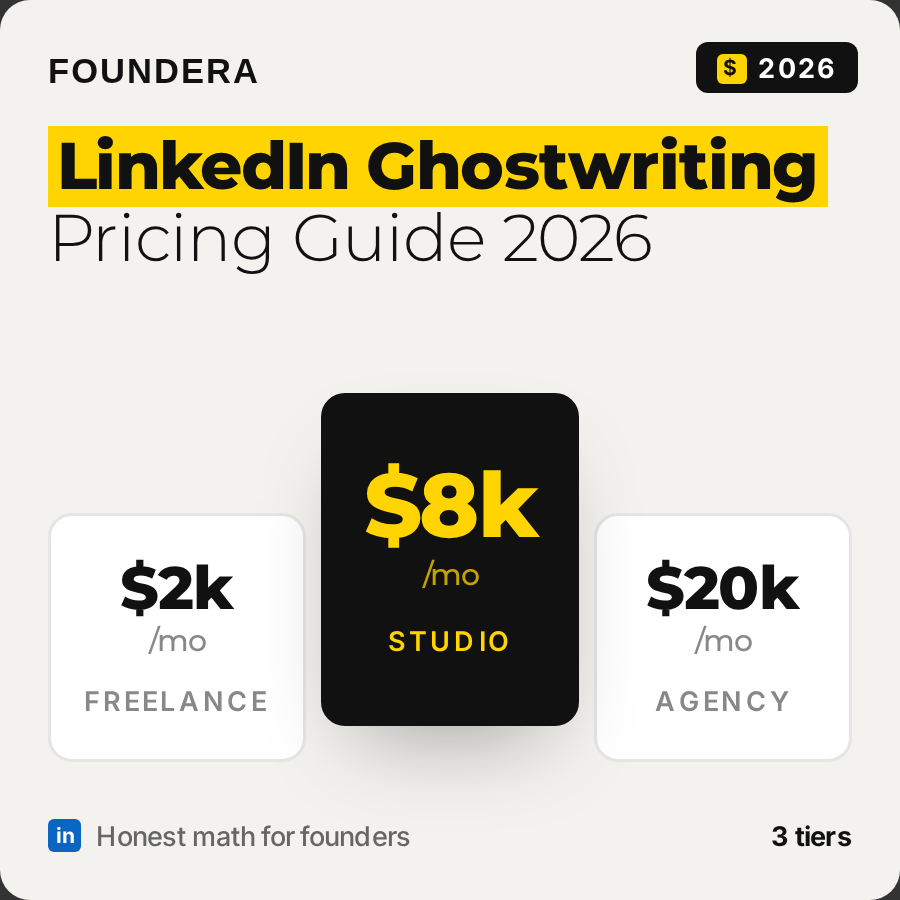
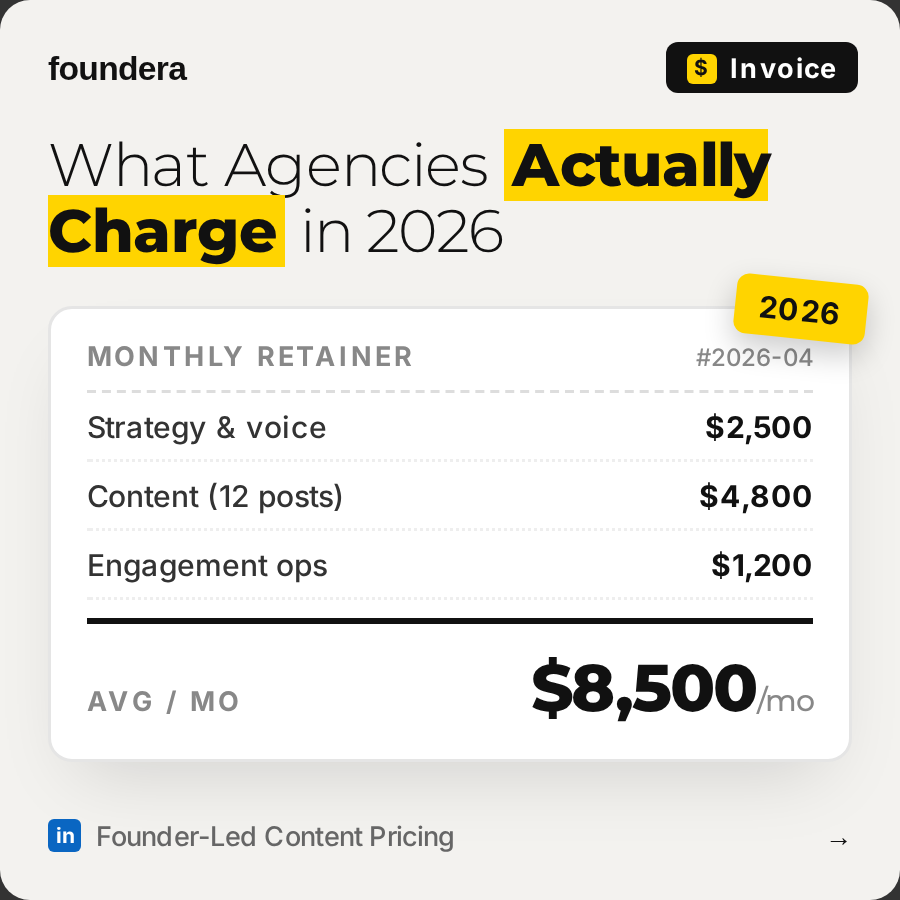
- Cost ($2,000–$5,000/month)
- Requires upfront voice matching (interview, feedback loops)
- Less direct control (you have to trust them)
- Takes 2–3 weeks to dial in voice
Time commitment: 1–2 hours/week (direction, approvals, engagement)
When to hybrid:
- You're Series A+ or actively fundraising
- You're in a high-pressure period (fundraising, scaling)
- You value consistency over total autonomy
- You want strategic guidance alongside founder-led content partnerships
In-House Hire (You Employ a Writer)
Pros:
- Long-term consistency (writer knows you deeply)
- Flexibility (they adjust to your schedule)
- Ownership mindset (building your brand)
Cons:
- Cost ($50K–$80K/year + benefits, taxes, etc. = $65K–$104K all-in)
- Hiring and management overhead
- Single point of failure (if they leave, you rebuild)
- Takes 8+ weeks to get useful output
Time commitment: 2–4 hours/week (strategy, direction, editing)
When to hire in-house:
- Series B+ (budget for it)
- You've found a great person (hard)
- You're committed to founder brand long-term (not just for fundraising)
Decision Framework
SituationRecommendationPre-seed, time availableDIYSeed, limited timeHybrid (agency)Fundraising activelyHybrid or in-houseSeries A+, high volumeIn-house or premium agencyScaling, need strategic consistencyHybrid or in-houseNot sure, want to testStart DIY, move to hybrid at month 2
Related reading: For a deep dive on the founder-led content partnerships option, see Founder-Led LinkedIn Growth: Building Authentic Thought Leadership. To understand the data behind founder-led strategies, read Founder-Led Marketing on LinkedIn. And if you're deciding between platforms, check LinkedIn vs. Twitter/X for Founder Branding.
FAQ
How long until I see results?
Week 2–3: Increased profile views (algorithm learning your cadence). Week 4–6: Meaningful engagement (15–25 comments per post). Month 3: Inbound DMs and genuine inquiries. Month 6: Sufficient inbound that you're selective about which opportunities to pursue.
Do I need to be "personal" or can I be all business?
Mix. 70% business expertise, 30% personal perspective. The personal stuff humanizes you and builds relatability; the expertise establishes authority. All business = boring; all personal = not credible.
What if I don't have 5 hours/week?
Post 2–3x/week instead of 5x/week. It'll take longer to build momentum, but consistency at lower frequency beats sporadic higher-frequency. Or use Foundera to handle the writing and engagement.
Should I worry about posting something controversial?
Thoughtful takes are fine. Inflammatory takes are risky. The bar: would you say this in front of a customer or investor? If not, don't post it. Smart opinions = good. Personal feuds or conspiracy theories = bad.
What if nobody engages with my posts?
Check three things: (1) Is your hook interesting? (First 1–2 sentences are 80% of engagement.) (2) Are you responding to comments? (If you post and ghost, algorithm notices.) (3) Are you talking to the right audience? (Post about AI to security people, not GenAI to DevOps folks.)
Can I repurpose content from Twitter/X?
Yes. LinkedIn rewards long-form (250+ words); Twitter is short-form. Take a Twitter thread idea and expand it to 300–400 words with examples and context. Different platforms, different audiences, different format.
How do I handle criticism or negative comments?
Respond calmly. If someone disagrees, say "Great point, here's how I'd push back…" Not defensive, not rude. Public disagreement handled well builds credibility. Deleting comments or arguing looks bad.
Should I connect with everyone who comments?
Yes. If someone took time to comment, send a connection request. Not a message (yet). Just a request. Some will accept, building your network. Many will become regular engagers.
How often should I mention my company or link to my website?
Rarely. One link per 10–15 posts is fine. LinkedIn penalizes over-promotion. Your goal is to be a thought leader, not a billboard. The company link in your About section and Featured section is enough.
What's the difference between a "post" and a "Newsletter"?
LinkedIn Posts reach your network + algorithm. LinkedIn Newsletter reaches subscribers (you have to build this separately). Newsletters are for 1 specific audience; posts are for broad discussion. Start with Posts; add Newsletter later (month 6+) if you want a subscriber-only channel.
Should I hire a founder-led content partnerships agency or just write more myself?
This depends on your timeline and commitment. See the DIY vs. Agency decision section. If you're fundraising or scaling hard, agency founder-led content partnerships is leverage. If you have time and love writing, DIY works.
Step 6: 90-Day Momentum Check
At day 90, pause and measure:
- Engagement: Are posts getting 15+ comments and 100+ reactions?
- Network: Have you grown followers 50%+? (e.g., 1K → 1.5K)
- Inbound: Have you received 3+ meaningful DMs or meeting requests?
- Content: Do you have 2–3 go-to topics that consistently perform?

If yes on all four, you're on the right track. Keep going.
If no, audit:
- Low engagement? Your hooks aren't interesting. Rewrite first 2 sentences of each post.
- No inbound? You might be talking to the wrong audience. Check who's engaging — are they customers/investors or just industry observers?
- Unclear topics? You don't have clear pillars yet. Go back to Step 2 and define them.
CTA
Building a personal brand on LinkedIn is one of the highest-ROI activities for founders. It takes time upfront, but compounds for years.
Too busy to do it yourself? Foundera handles the strategy, writing, engagement, and measurement. We specialize in tech founders (cybersecurity, AI, DevOps) and include influencer amplification at no extra cost. Book a 20-minute strategy call to discuss whether founder-led content partnerships is right for you now.
Want to do it yourself? Use this guide. Set a 90-day goal (30 consistent posts, 3+ engagement habits, 2–3 inbound conversations). Measure it. Adjust. By month 4, you'll know if it's working.
Either way, start this week. The compound returns of founder brand are too valuable to delay.