Table of Contents
- LinkedIn as a B2B Lead Gen Channel (The Data)
- The Content-to-Pipeline Funnel
- Content Formats That Generate Leads (Ranked by Conversion)
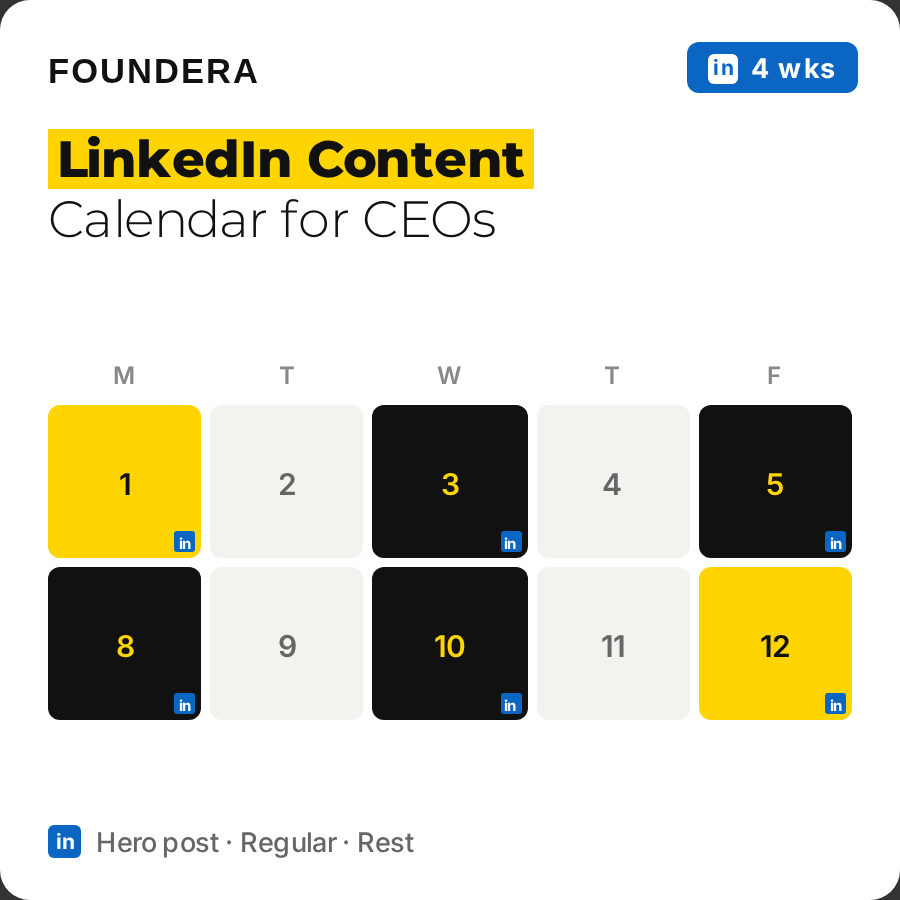
- The Ideal Posting Cadence for Lead Gen
- Engagement Tactics That Convert Followers to Leads
- Measuring LinkedIn Content ROI (KPIs and Benchmarks)
- Case Study: From 0 to 250 Inbound Leads via LinkedIn
- FAQ
- Summary
LinkedIn has become the dominant B2B lead generation platform. According to Social Media Examiner, LinkedIn accounts for 80% of all B2B social media leads—more than Twitter, Facebook, and Instagram combined. But not all LinkedIn content converts equally. The difference between a post that reaches 200 people and one that generates qualified pipeline isn't luck; it's strategy.
This guide breaks down the content-to-pipeline funnel, ranks content formats by conversion potential, and reveals the engagement tactics that turn followers into actual leads. You'll see real benchmarks, KPI frameworks, and a case study showing how to scale from zero to 250 inbound leads through LinkedIn alone.
LinkedIn as a B2B Lead Gen Channel (The Data)
LinkedIn's advantage in B2B isn't coincidental. The platform's user base skews toward decision-makers: according to LinkedIn's own research, four out of five LinkedIn members drive or influence business decisions at their organization.
That concentration of buyer intent makes LinkedIn fundamentally different from consumer social platforms. Where Instagram drives brand awareness and Twitter drives thought leadership, LinkedIn drives pipeline.
Why LinkedIn Dominates B2B Lead Gen
1. Buyer Intent LinkedIn users are there to advance their careers and find solutions. They're not scrolling mindlessly between cat videos. When they engage with your content, there's implicit intent to learn.
2. Searchability LinkedIn's search functionality lets buyers find you by job title, company, industry, and skill. Your profile doubles as a lead magnet. Every connection is a warm inbound lead.
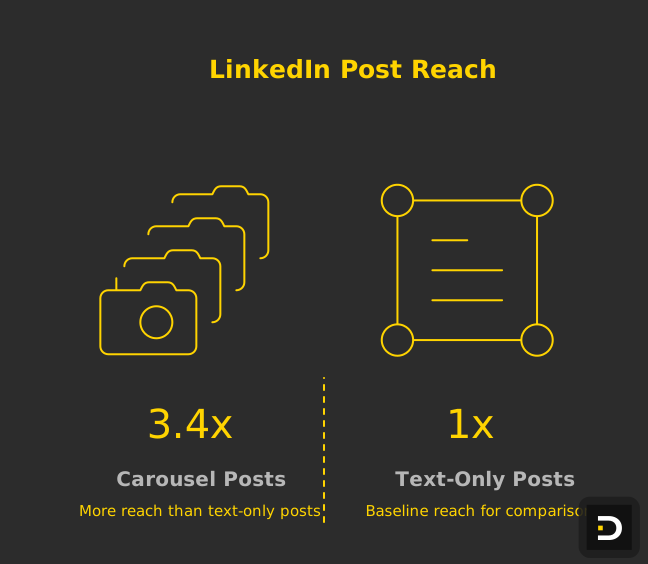
3. Platform Dynamics According to LinkedIn's internal data, carousel posts achieve 3.4x more reach than text-only posts. Video posts with captions get 5x more engagement than text alone. The algorithm rewards specific content formats, and we'll detail those below.
4. Network Effect Comments from your first-degree network trigger algorithmic amplification. According to engagement research, posts with meaningful comments in the first 60 minutes see 150–300% reach increases compared to posts with no comments.
LinkedIn's Position in the B2B Buyer Journey
B2B purchases are complex. Deals take 4–6 months minimum. Decision committees are large. The path to close involves multiple touchpoints.
LinkedIn captures buyers at two critical moments:
- Awareness phase: Content that educates positions you as an authority. Buyers discover you.
- Consideration phase: In-depth content helps buyers evaluate options. They engage, connect, message.
The platform doesn't usually close deals directly, but it fills the top and middle of the funnel reliably.
The Content-to-Pipeline Funnel
Understanding how content moves people from impression to pipeline is essential. Here's the funnel framework that B2B companies use:
Funnel StageWhat HappensTypical ConversionMetric to TrackImpressionsSomeone sees your post100% (baseline)Post impressionsEngagementSomeone likes, comments, or shares5–15%Engagement rateProfile ViewsSomeone visits your profile40–60% of engaged usersMonthly profile viewsConnectionSomeone sends a connection request30–50% of profile visitorsNew connectionsConversationSomeone DMs or replies20–40% of connectionsInbound messagesLeadSomeone qualifies as potential customer10–25% of conversationsQualified leads
The math here matters. If a post reaches 10,000 people and generates a 10% engagement rate, that's 1,000 engaged users. Of those, 400–600 visit your profile. Of those, 120–300 connect. And of those, 24–120 send meaningful messages.
Start with a weak funnel (low engagement rate, low profile-visit rate, weak CTA), and even high impressions won't generate leads. The work is in optimizing conversion at each stage.
Content Formats That Generate Leads (Ranked by Conversion)
Not all content formats perform equally. We've ranked the most common formats by their ability to drive engagement, profile visits, and ultimately pipeline:
RankFormatEngagement RateProfile ViewsConversion to LeadsBest For1Carousel posts with data/frameworks8–15%High (65–75%)High (15–25%)Educational content, frameworks, lists23–5 min video with captions6–12%High (60–70%)Medium-High (12–20%)Personal insights, customer stories3Text post with controversial take5–10%Medium (45–55%)Medium (8–15%)Thought leadership, industry hot takes4Customer case study post7–12%High (70–80%)High (18–25%)Social proof, specific results5Long-form article with breakout quote4–8%Medium (40–50%)Medium (10–18%)Deep dives, SEO benefits6Link post (article preview)2–5%Low (20–30%)Low (3–8%)Quick reads, external authority7Text-only post2–4%Low (15–25%)Low (2–5%)Announcements, quick takes8Polls and questions8–12% (engagement)Low (10–20%)Low (1–3%)Engagement metrics only
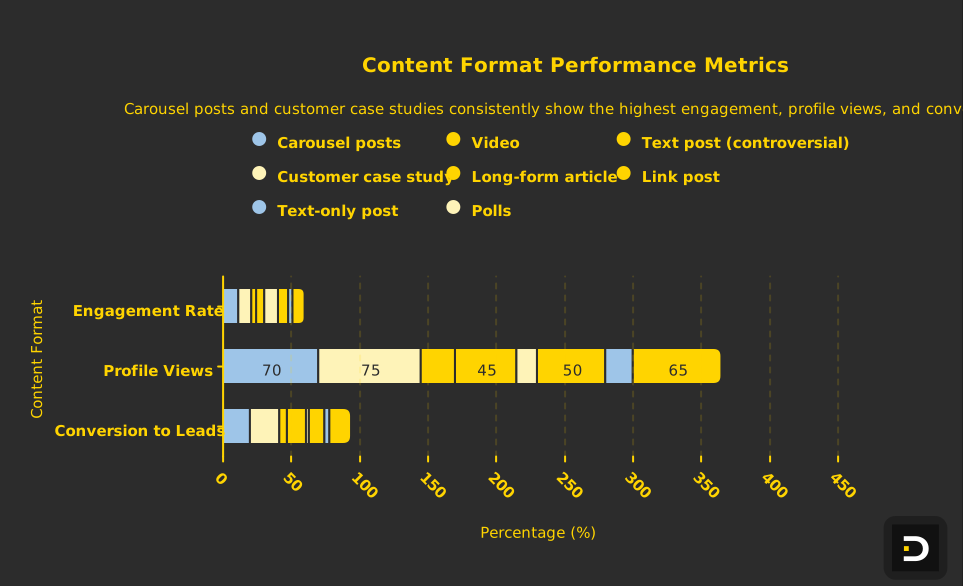
Why carousels and case studies win: Carousels force viewers to swipe, increasing dwell time and engagement. According to LinkedIn internal data, this extended interaction signals value to the algorithm. Case studies provide proof and specificity. When someone sees concrete results, they're compelled to visit your profile and learn more.
Why polls underperform for leads: Polls are engagement traps. They generate high engagement rates but low-quality engagement. People answer polls casually. They don't visit your profile or consider buying. Optimize for the right engagement metric—meaningful, not vanity.
The Best Carousel Frameworks for Lead Gen
Specific carousel topics consistently outperform:
- "5 ways to [solve the pain point]"
- "Biggest mistakes I see [target audience] make"
- "What [industry] looks like in 2026 vs. 2020"
- "Why [conventional wisdom] is wrong"
- "ROI benchmarks for [solution]"
- "How to hire/evaluate/implement [your domain]"
Each slide should take 8–12 seconds to read. Use visuals for at least 50% of slides. Close with a CTA that invites connection or messengers ("What's your biggest challenge?" or "Want to discuss?").
The Ideal Posting Cadence for Lead Gen
Frequency questions are common, and the answer depends on your content quality and audience.
Posting Cadence Benchmarks
Posting FrequencyExpected Reach Per PostEngagement RateBest ForRisk1x per week8,000–12,000 impressions8–12%High-quality focus, slower burnVisibility fade2–3x per week5,000–8,000 per post7–10%Consistent presence, sustainableAlgorithm may thin reach4–5x per week3,000–5,000 per post5–8%Daily engagement, habit buildingFollower fatigue, lower qualityDaily2,000–3,000 per post3–6%Aggressive top-of-funnelFollower churn, low quality
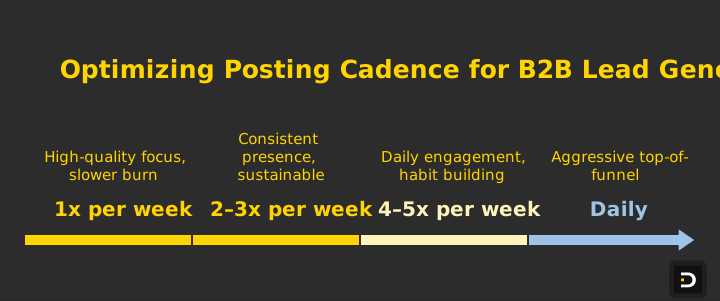
The sweet spot for B2B lead gen: 2–3x per week with high-quality content beats daily posting with average content. LinkedIn's algorithm rewards consistency, not volume. If you post daily, you're competing with yourself—each post cannibalizes reach for others.
The research backs this up: according to HubSpot's LinkedIn study, B2B accounts posting 2–3x weekly see 60% higher engagement rates than those posting daily or less than once weekly.
Timing and Day-of-Week Effects
Best days: Tuesday, Wednesday, Thursday (75% of engagement happens here)
Best times: 7–9 AM and 12–1 PM (peak LinkedIn usage)
Consistency matters more than timing: If you post every Tuesday at 10 AM, you'll build a viewing habit. If you post randomly, the algorithm deprioritizes you.
Engagement Tactics That Convert Followers to Leads
Posting content isn't enough. Engagement on your posts directly determines algorithmic reach. Here's how to drive meaningful engagement:
The First-Hour Rule
LinkedIn's algorithm examines post engagement in the first 60 minutes to decide algorithmic amplification. Posts with meaningful comments (not emojis) in that window see 2–3x higher distribution to secondary networks.
Tactic: Reply to every comment in the first hour with a substantive response. Don't just say "Thanks!" Ask a follow-up question that invites further conversation. When someone comments "This is great," respond with "Glad it resonates. What's your biggest challenge with [topic]?"
Build a Core Engagement Group (The Right Way)
There's a difference between organic engagement networks and inauthentic pods. The LinkedIn algorithm detects pod patterns: the same 5–10 accounts commenting on your post within 3 minutes, then disappearing. These patterns now trigger reach penalties.
What works: Cultivate relationships with 5–10 authentic influencers and experts in your field who actually want to engage with your work. They comment because they find it valuable, not because of a rotation schedule. These real comments drive meaningful reach.
Encourage DMs and Replies
Your caption should make people want to respond. Generic CTAs ("Like and share!") don't work. Specific, curiosity-inducing CTAs work:
- "What's your experience with [topic]?" (invites comments)
- "I'd bet you've seen this before—agree or disagree?" (invites debate)
- "DM me if you want the full framework" (invites DMs)
- "Comment with your answer below" (fills comments with context)
According to LinkedIn's engagement data, posts with clear, specific CTAs see 40–60% higher comment rates than posts with generic CTAs.
Engage with Others' Content (The Often-Forgotten Tactic)
Your own post reach depends partly on your overall account activity. Accounts that engage with others' content—thoughtfully commenting, sharing, reacting—get higher algorithmic boost for their own posts.
The math: Spend 30 minutes per day engaging with content from 10–15 accounts in your network. Leave 2–3 substantive comments. This signals to the algorithm that you're an active, engaged community member, not a broadcast account.
Measuring LinkedIn Content ROI (KPIs and Benchmarks)
Not all metrics are created equal. Vanity metrics like total followers don't predict revenue. Focus on metrics that connect to the pipeline.
The B2B LinkedIn KPI Stack
KPIBenchmarkWhy It MattersLead Gen Signal?Engagement Rate5–10%Shows content qualityMediumProfile View Rate (views per post)40–60% of engaged usersShows interest in youHighConnection Request Rate20–40% of profile visitorsShows explicit interestHighInbound Message Rate15–30% of new connectionsShows sales-ready interestVery HighMessage Response Quality30–50% ask about your workShows buyer intentVery HighPipeline Sourced from LinkedIn$ value of closed dealsShows ROICritical
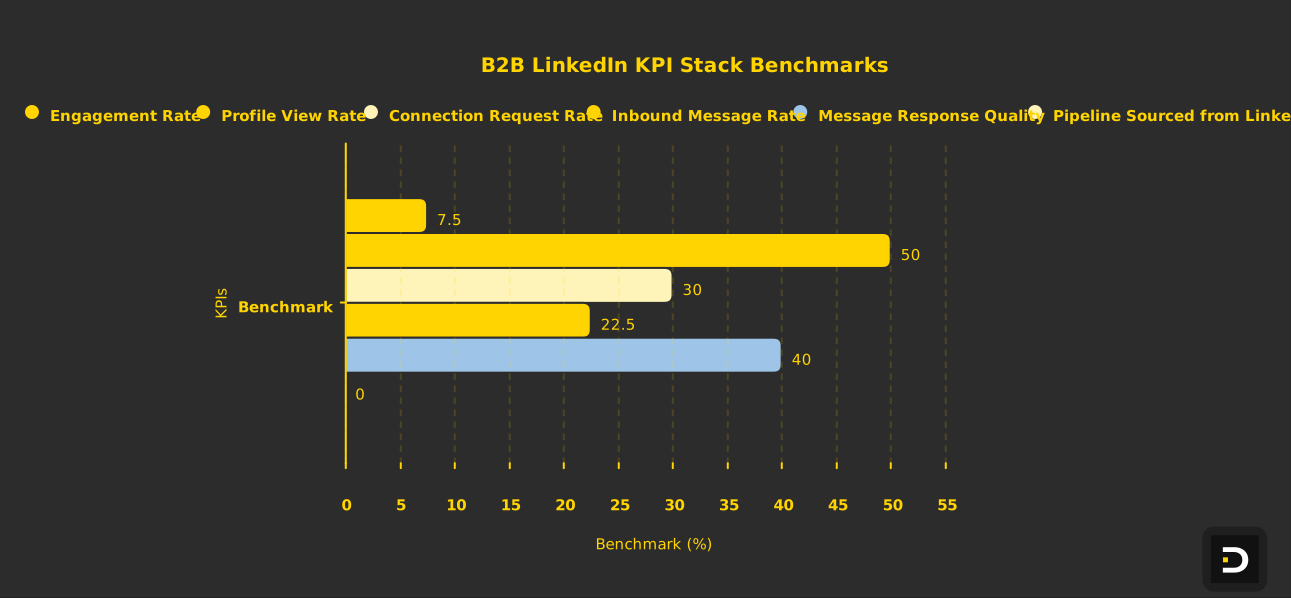
What separates B2B success from vanity metrics: A post with 100 engagements is worthless if 0 people visit your profile. A post with 50 engagements that drives 30 profile views and 10 connection requests is the winning formula.
Calculating LinkedIn Content ROI
The basic formula:
LinkedIn Content ROI = (Revenue from LinkedIn-sourced deals) / (Time investment + paid spend)
For a founder or marketing leader spending 4 hours per week on LinkedIn content, that's:
- 200 hours per year invested
- If your hourly rate is $150/hour, that's $30,000 in time cost
- If LinkedIn content sources 3–5 deals per year worth $50K–$200K each, the ROI is 5–33x
But it takes 3–6 months to see traction. This isn't a 30-day channel.
Real-World Benchmark Data
According to research from LinkedIn itself and corroborating studies from HubSpot:
- Top 10% of B2B LinkedIn accounts generate 30–50 inbound leads per month from LinkedIn posts alone
- Middle performers generate 5–15 per month
- Bottom performers generate 0–2 per month
The difference? Consistency, content quality, and engagement discipline. Top performers post 2–3x weekly, engage daily, and optimize for profile views and DMs—not vanity metrics.
Case Study: From 0 to 250 Inbound Leads via LinkedIn
A B2B SaaS company (100 employees, $10M ARR) started with a founder who had 200 LinkedIn followers and hadn't posted in two years. Here's what happened over 6 months:
Month 1–2: Building the Foundation
Actions:
- Posted 2x weekly: carousels on frameworks, customer stories
- Engaged with 15 related accounts daily (10 min/day)
- Optimized profile with clear value proposition and CTA
Results:
- Followers: 200 → 850
- Monthly profile views: 100 → 800
- Inbound messages: 2–3 per month → 8–10
Lead gen: 2 conversations that qualified
Month 3–4: Scaling Content
Actions:
- Posted 2x weekly carousel posts (stopped text-only posts)
- Created 1 video post per month
- Built a small curated engagement network (5 influencers)
- Implemented "first-hour engagement rule"—responded to all comments within 60 minutes
Results:
- Followers: 850 → 2,200
- Monthly profile views: 800 → 2,400
- Average engagement rate: 7–8%
- Inbound messages: 15–25 per month
Lead gen: 8–12 qualified conversations per month
Month 5–6: Optimization and Scale
Actions:
- Refined carousel format based on performance data
- Introduced case study posts (highest conversion format)
- Doubled down on DM engagement—responded to every message within 2 hours
- Tested LinkedIn ads to amplify top-performing organic posts ($500/month budget)
Results:
- Followers: 2,200 → 4,100
- Monthly profile views: 2,400 → 4,500
- Average engagement rate: 8–10%
- Inbound messages: 40–50 per month
Lead gen: 20–30 qualified conversations per month; 8–12 that moved to sales calls
6-Month Outcome
- Total inbound conversations: 250+
- Qualified leads: 50–60
- Sales conversations: 20–25
- Closed deals: 4–6 (at $15K–$50K ACV)
- Revenue sourced from LinkedIn: $80K–$250K
- Time investment: 4–5 hours per week (founder + 1 part-time marketing person)
The ROI math on this one is stark: $100K–$250K revenue from $10K–$15K in time cost.
What Made the Difference
- Consistency over perfection: Posted regularly even when uncertain
- Format discipline: Carousel posts were the foundation (60% of top posts)
- First-hour engagement: Replies in the first hour boosted algorithmic reach
- Profile optimization: Clear profile description increased conversion from view to connection by 40%
- Authentic network: Real influencer relationships (not pods) drove meaningful amplification
- DM follow-up: Every inbound message received substantive response within hours
This wasn't magic. It was disciplined execution of a proven framework.
FAQ
Q: How long before I see leads from LinkedIn content? A: Expect 4–6 weeks before meaningful traction. The first 12–16 posts build authority and follower base. Leads typically start appearing in week 5–6 as profile visits and connection requests increase. Peak results usually hit 3–4 months into consistent posting.
Q: Should I use hashtags? A: Yes, but sparingly. Use 3–5 relevant hashtags per post. Avoid generic hashtags (#LinkedIn, #motivation). Target niche hashtags with 10K–100K followers. According to engagement research, posts with 3–5 targeted hashtags see 15–25% higher reach than posts with zero or >8 hashtags.
Q: Can I repurpose content across platforms? A: Partially. LinkedIn content performs differently than Twitter or your blog. Repurpose by adapting, not by copy-pasting. A carousel might become a Twitter thread. A video might become a blog post. But each should be tailored to platform norms and audience expectations.
Q: What's the ideal length for LinkedIn posts? A: 100–200 words for standalone posts. Longer posts (400–600 words) work if formatted with line breaks and headers. LinkedIn's algorithm doesn't penalize length, but readability matters. Long walls of text perform worse than scannable posts.
Q: Should I post less frequently and focus on quality, or post more often and accept lower engagement per post? A: Quality over quantity. 2–3 high-quality posts weekly beat daily average posts. According to HubSpot's data, B2B accounts posting 2–3x weekly with >7% engagement rates generate 3–4x more pipeline than accounts posting daily with 3–4% engagement rates.
Q: How do I measure whether content is actually driving leads? A: Use UTM parameters in your profile links and CTAs to track attribution. In your CRM, ask every inbound lead: "Where did you hear about us?" Most will say LinkedIn. Over time, you'll see clear correlation between content consistency and lead volume. Use LinkedIn's native analytics (available with a Creator Account) to track profile views and search appearances.
Q: Is LinkedIn advertising necessary for lead gen, or can organic work alone? A: Organic alone can work, but ads accelerate results. In the case study above, $500/month in ads amplifying top organic posts added ~20% incremental reach. For most B2B companies, 90% of results come from organic content, 10% from ads. Ads are a multiplier, not a foundation.
Related reading: For a deeper look at why founder voices outperform brand pages, see Founder-Led Marketing on LinkedIn. Curious about engagement tactics? Read LinkedIn Engagement Pods vs. Organic Growth to understand what the algorithm actually rewards. And for the hard ROI numbers, see ROI of LinkedIn Thought Leadership for B2B SaaS.
Summary
LinkedIn has become the B2B lead generation channel because it concentrates buyer intent and decision-makers in one place. But generating leads requires systematic approach: specific content formats (carousels and case studies outperform), consistent posting cadence (2–3x weekly beats daily), and engagement discipline (first-hour replies matter).
The funnel is clear: impressions → engagement → profile views → connections → conversations → leads. Optimize at each stage, and you'll see 5–30 qualified conversations per month within 3–6 months.
The case study proved it: a founder with no LinkedIn presence generated 250+ inbound conversations and $80K–$250K in revenue over 6 months using consistent content, the right formats, and daily engagement.
Start with carousels and case studies. Post 2–3x weekly. Engage with your network daily. Watch profile views and inbound messages, not follower count. Measure what matters: pipeline, not vanity.
LinkedIn lead gen works at scale. The question isn't whether it can work—it's whether you're willing to show up consistently.
Ready to turn your LinkedIn presence into a lead generation engine? Foundera's network amplification service drives 70–150% engagement increases through curated influencer relationships—not pods, not bots, not shortcuts. Learn how we've helped tech founders scale.