LinkedIn Content for AI Startup Founders: Standing Out When Everyone's Talking AI
Every founder is talking about AI right now. Every founder thinks they're an AI founder now. Every post is "AI is changing everything" or "Here's what AI means for your industry."
It's noise. And it's making it harder for actual AI founders to be heard.
If you're building an AI product or company, your LinkedIn strategy needs to stand out from the crowd of people who watched a few ChatGPT demos and now consider themselves AI experts. The way you do that is by being specific, technical where it matters, and grounded in real problems.
This guide covers how AI founders actually win on LinkedIn: what topics resonate, how technical to be, demo strategy, what not to do, and what engagement benchmarks look like.
Table of Contents
- The AI LinkedIn Noise Problem
- Core Content Pillars for AI Founders
- Technical Depth vs. Accessibility Balance
- Demo and Product Content That Works
- Topics That Resonate with Technical Audiences
- What NOT to Post as an AI Founder
- Building Authority in AI
- Engagement Benchmarks for Technical Content
- FAQ: AI-Specific Strategy Questions
The AI LinkedIn Noise Problem
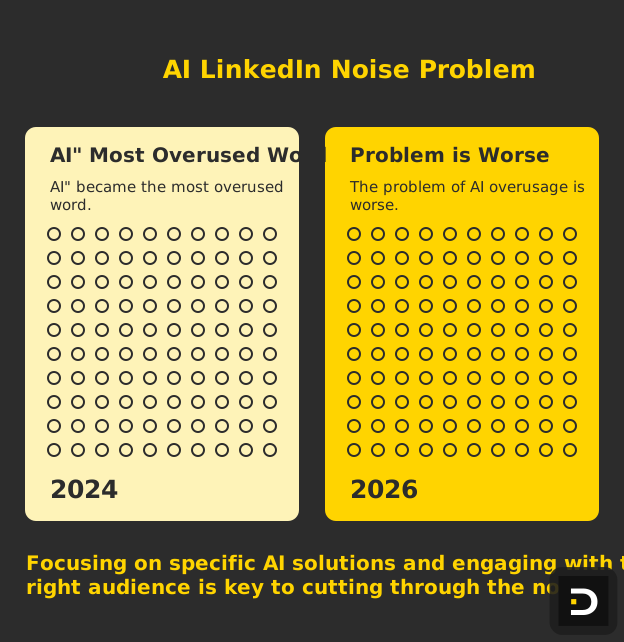
In 2024, "AI" became the most overused word on LinkedIn. In 2026, the problem is worse. Everyone is trying to sound like they understand AI. Most don't.
This creates an opportunity for actual AI founders. The smart ones on LinkedIn right now are the ones who've stepped back from "AI is the future" and gone specific: "Here's how we solved transformer inference latency," or "Most AI products solve fake problems—here's what actually matters."
The noise creates an expectation: AI founders should be talking about groundbreaking stuff. They shouldn't be talking about adoption curves or feature releases or go-to-market challenges. But those are often the most interesting conversations.
The winning move is to ignore the noise and talk to your actual audience: other founders, engineers, and people who want to build AI products the right way.
Core Content Pillars for AI Founders
Your LinkedIn strategy should have 4–5 pillars that return regularly. For AI founders, here's what works:
Pillar 1: The technical realities of building AI products. This is "Here's what nobody tells you about building with LLMs," or "We spent two months optimizing inference, and here's what worked." This separates actual builders from people who've played with ChatGPT.
Example: "Every AI startup talks about fine-tuning. Most fine-tune the wrong model on the wrong data. Here's what we learned."
Pillar 2: Separating hype from reality. This is maybe the most valuable pillar for 2026. "People think AI can do X, but here's why it can't (yet)," or "Everyone's excited about multimodal LLMs, but the real bottleneck is data." This positions you as someone who thinks clearly.
Example: "RAG is being sold as a solution to everything. It's not. Here's what it actually solves and what it doesn't."
Pillar 3: The go-to-market and business side of AI. How do you sell an AI product? How do you talk to enterprises about AI capabilities? What does SLA look like when your product is AI-based? This resonates heavily with founders who are shipping but haven't figured out distribution.
Example: "We spent three months figuring out how to price an AI product. Here's what we learned about how enterprises think about AI pricing."
Pillar 4: Hiring and building AI teams. "How do you hire great ML engineers?" "What does a healthy AI product team look like?" "How do you avoid hiring hype?" This speaks to a huge pain point for AI founders.
Example: "We hired five ML engineers in the last year. The best hire didn't have a PhD. Here's what we look for now."
Pillar 5: Specific technical opinions. Pick an area where you have a distinct point of view. Fine-tuning vs. RAG vs. prompt engineering? Open source vs. proprietary models? Inference optimization vs. latency? Return to it repeatedly.
Example: "Everyone's obsessed with fine-tuning. We're investing in retrieval. Here's why retrieval is a bigger moat."
These pillars work because they separate signal from noise. You're not adding to the hype. You're thinking clearly about hard problems.
Technical Depth vs. Accessibility Balance
This is the key tension for AI founders on LinkedIn: How technical should you be?
The answer: be as technical as makes sense, but never be technical for the sake of being technical.
A technical post that works: "We run inference on a custom CUDA kernel instead of PyTorch's standard implementation. Here's the latency improvement and why it matters for our product."
This assumes the reader understands CUDA, inference, and PyTorch. You're not explaining those basics. You're diving into a specific implementation choice. Engineers will appreciate it. Non-engineers will be a bit lost, but they'll respect the specificity.
A technical post that doesn't work: "We optimized our transformer's attention mechanism to use flash attention v2, which reduces memory complexity from O(n²) to O(n log n), allowing us to process longer sequences with lower latency."
This is technically impressive but meaningless to most audiences. You've explained the what without explaining the why or the business impact. Simplify it.
The right balance: Assume your audience is smart but not necessarily an ML engineer. Explain what you did, why it matters, and what the result was. Then drop into technical details for people who want them.
Example of balanced technical content:
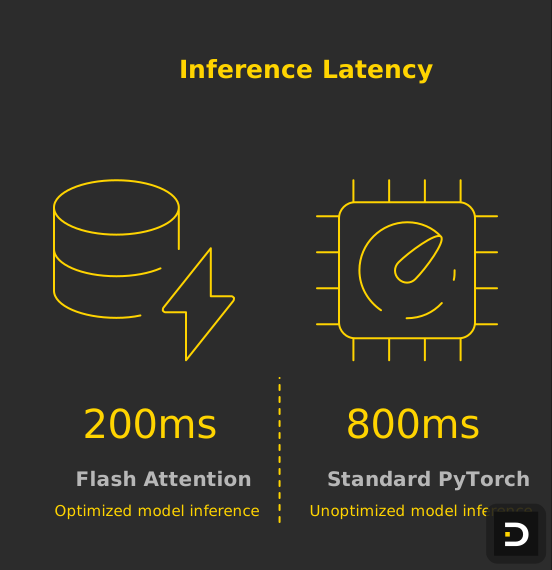
"We spent two months optimizing our model's inference latency. The biggest win: instead of using standard PyTorch attention, we switched to flash attention. This cut our latency from 800ms to 200ms per request. For a product where users are waiting for responses, that's the difference between acceptable and unusable. Here's what we learned about premature optimization..."
This works because it explains the context (why speed matters), the solution (what you changed), the impact (how much faster), and the lesson. A non-technical founder gets it. An engineer gets it and wants to ask follow-up questions.
Demo and Product Content That Works
Demos are tricky for AI products. Here's what actually works:
Product demos that show failure modes: Most founders show their product working perfectly. More interesting: "Here's where our product fails," or "Here's a use case we can't handle yet." This is credible because it's honest.
Example: "We built an AI product to summarize meetings. We demo'd it to 50 founders. On 20% of recordings, the model hallucinated—created facts that didn't exist. Here's what we learned about when LLMs hallucinate and how to catch it..."
Demos that show iteration: "Here's our first version of the product and here's v3. Here's what we learned in between." People love watching progress. It's credible and it shows thinking.
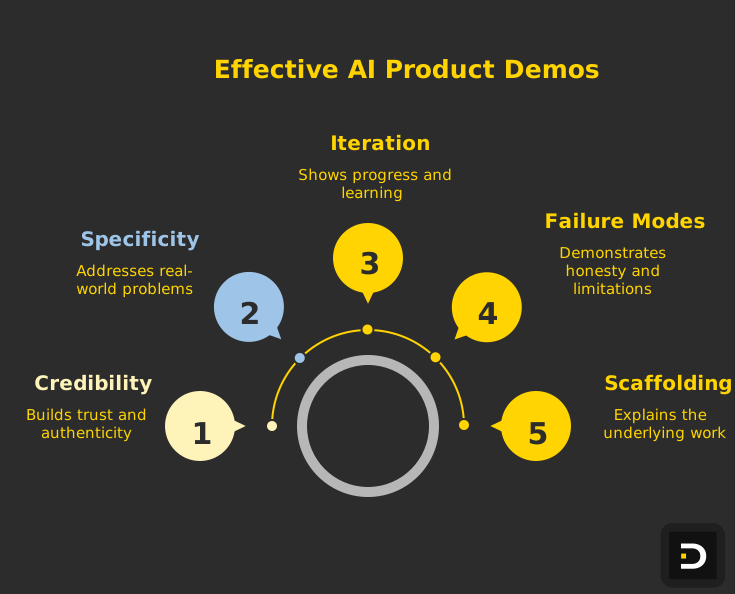
Demos that are specific to a problem: Not a generic "Look, AI!" demo. A specific "Here's how this AI solves problem X for company Y" demo. "We built this for regulatory teams. It reads 10-K filings and flags risk. Here's a real example..."
Demos that explain the scaffolding: The uninteresting part of AI products is the scaffolding: the prompts, the retrieval, the error handling, the retries. But that's where most of the work is. A post like "Here's the prompt engineering it took to get reliable outputs" is gold because it's honest about the work.
Demos you should NOT do:
Pure "Here's our product, buy it" posts. These get low engagement from practitioners.
Demos of your product beating ChatGPT or Claude. Most smart people won't believe you, or they'll think you're cherry-picking examples.
Demos that show off technology without context. "Look, we're using mixture of experts!" doesn't mean anything without the problem it solves.
Topics That Resonate with Technical Audiences
Here's what actually drives engagement when AI founders post:
LLM fine-tuning and training (high engagement, 2–4% rates): "We fine-tuned a model on our data. Here's what happened" gets responses. People want to know if fine-tuning actually works, when it's worth it, and how to do it right.
Hallucination and reliability (very high engagement, 3–5% rates): "Here's how we catch hallucinations," or "We built guardrails for reliability. Here's the framework." This resonates because reliability is the unsolved problem in AI products.
Prompt engineering and in-context learning (high engagement, 2–3% rates): People want to understand prompt engineering without the hype. "We spent three weeks optimizing prompts. Here's what we learned" gets responses.
Data and datasets (medium-high engagement, 2–3% rates): "Here's what we learned about data quality for AI," or "We built a dataset for training. Here's the surprising challenge." Data is boring but critical. Posts about it attract practitioners who think deeply.
Inference optimization and latency (high engagement, 2–4% rates): "We cut inference latency in half. Here's how." Engineers care about this deeply. It's technical but concrete.
Model selection (medium engagement, 1–3% rates): "We evaluated 5 open-source models and chose X. Here's why." People want to know which models work in practice.
Cost and economics of AI (high engagement, 2–4% rates): "We thought inference would cost $X. It actually costs $Y. Here's why." Founders are obsessed with unit economics. Any post about AI costs and pricing gets engagement.
Building vs. buying vs. open source (high engagement, 2–3% rates): "We evaluated building our own model vs. using Claude vs. fine-tuning Llama. Here's what we chose and why." This is a decision every founder faces.
Long-context and retrieval (medium-high engagement, 2–3% rates): "Context windows keep growing. We're using 100K tokens now. Here's what changed..." Or "We switched from fine-tuning to RAG. Here's why."
What doesn't work: generic "AI is changing everything," reposting news about model releases, talking about AGI predictions, benchmarks without context.
What NOT to Post as an AI Founder
Some things will kill your credibility with technical audiences:
Hype without substance. "AI will solve climate change" without any reasoning or framework reads as empty. Don't do it.
False authority claims. "I'm an AI expert" when you've been building for 6 months is a credibility killer. "I'm learning a lot about AI products" is honest.
Predictions you can't back up. "This model will be 10x better" sounds like a guess. "Here's why I think this architectural change matters" is defensible.
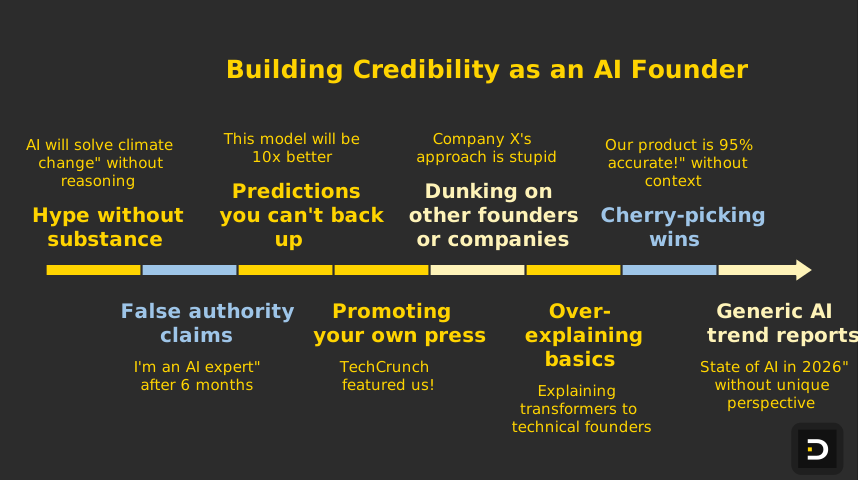
Promoting your own press. Sharing "TechCrunch featured us!" is fine. Posting "We're the most innovative AI company" is cringe.
Dunking on other founders or companies. "Company X's approach is stupid" marks you as unprofessional. "We disagree with Company X's approach, here's why..." is a post.
Over-explaining basics. If your audience is technical founders, don't spend two paragraphs explaining what a transformer is. They know.
Cherry-picking wins. "Our product is 95% accurate!" means nothing without context. On what task? What's the baseline? What counts as accurate? Be specific.
Generic AI trend reports. "State of AI in 2026" without your unique perspective is low-value. "Here's what I think matters in AI for 2026 based on what we're seeing" is a post.
Building Authority in AI
How do you build credibility as an AI founder when everyone claims to be an AI expert?
Show your work. Post about your actual process, your failures, your iterations. "Here's what didn't work and why" is more credible than "Here's what we built perfectly."
Be specific about your expertise. You're not an expert in all of AI. You might be expert in transformer inference, or RAG systems, or fine-tuning for domain-specific tasks. Say that. Let people know exactly what you know deeply.

Stay humble about what you don't know. If someone asks about something outside your expertise, say so. This is more credible than pretending to know everything.
Engage authentically. Comment thoughtfully on other people's posts, especially people who disagree with you. Show that you're willing to have your thinking challenged.
Write long-form when you have something substantial. LinkedIn documents (that you can publish directly) let you write 2000+ word pieces on specific topics. If you have a framework or a detailed case study, use that format.
Collaborate or credit others. If you've learned from someone else's work, credit them. If you're building on someone's research, cite it. This builds community and shows you're not trying to take credit for everything.
Engagement Benchmarks for Technical Content
What should you expect from technical AI founder content?
Month 1–2: 1–2% engagement rate. A post with 500 impressions and 5–10 comments is solid.
Month 3–4: 2–3% engagement. You should be hitting 50+ comments on some posts if you have 2000–5000 followers.
Follower growth: Technical founders who post consistently see 5–15% monthly growth in followers until they hit 5000–10000, then it slows.
Comment quality: Technical audiences leave fewer but smarter comments. 20 detailed comments from engineers is better than 100 generic reactions.
Inbound: You should be getting 5–10 DMs per month from people saying things like "I'm building something similar, let's talk" or "Your post helped us make a decision." This is the real benchmark.
Profile visits: 2–3x increase within 90 days of consistent technical posting.
Don't expect viral on technical content. Viral is for general audiences. Your goal is deep engagement with people who actually understand your space.
FAQ: AI-Specific Strategy Questions
Q: Should I post about my company's fundraising or metrics?
A: Sparingly. "We raised a Series A" is fine as a post. "Our ARR is $X" can work if you tie it to a lesson (e.g., "Here's how we got to $500K ARR in 12 months. Here's what worked..."). Don't make it pure press release.
Q: How do I handle criticism or people who disagree with my technical takes?
A: Engage with it thoughtfully. If someone has a valid counter-argument, acknowledge it. "That's a fair point, here's why I still think..." is a great response. If someone's just being contrarian, you can ignore it or reply briefly. Avoid getting defensive.
Q: Can I promote my product on my posts?
A: Yes, but sparingly. 90% of posts should be pure thought leadership. 10% can be product announcements or "Here's what we built based on what we learned."
Q: Is it okay to talk about model capabilities and limitations?
A: Yes, absolutely. "This model struggles with X" is valuable. It shows you've actually used it and tested it. It's credible.
Q: Should I be posting code or technical details?
A: Selectively. A code snippet showing an interesting pattern works. A full engineering breakdown can work in a LinkedIn document. Don't post proprietary code or code that would directly help competitors.
Q: How do I differentiate my AI content from everyone else's?
A: By being specific about your own experience, not general about industry trends. Talk about your problems, your solutions, your learnings. Not "AI is transforming marketing." "Here's how we're using AI in our product, and it's harder than we thought."
Ready to Build Your AI Founder Authority?
The best AI founders on LinkedIn aren't the ones hyping AI. They're the ones thinking clearly about hard problems, being honest about constraints, and building real things.
If you're an AI founder building your presence, focus on your core pillars, stay specific and technical, and engage authentically. The authority will follow.
For a comprehensive framework on building executive thought leadership, see the 2026 executive LinkedIn content strategy.
Or explore how to support your content strategy: A guide to hiring a LinkedIn ghostwriter for CEOs or complete guide to hiring the right LinkedIn ghostwriter.